
what rem sleep actually does
rem stands for rapid eye movement. it’s the stage of sleep where your brain is most active — more active than in deep sleep, sometimes close to waking levels. your eyes move around behind your eyelids, your muscles are temporarily paralyzed, and most of your vivid dreaming happens here. but the reason rem matters isn’t just dreaming. rem sleep is when your brain does a lot of its emotional processing. it essentially runs through the day’s experiences and files them — neutralizing some of the emotional charge from difficult things, consolidating memories, making connections between ideas. people who are consistently rem-deprived tend to be more emotionally reactive, less able to handle stress, and often struggle more with anxiety. there’s also a link between rem sleep and learning. a body of research out of Harvard and other institutions has consistently shown that rem sleep plays a critical role in procedural memory and creative problem solving. it’s not just rest. it’s active processing. you get most of your rem in the second half of the night — the 4am to 7am window, roughly. which means cutting sleep short, even by an hour or two, disproportionately cuts into rem time.how much rem sleep do you actually need
the general figure is around 20 to 25 percent of total sleep time. so if you’re sleeping 7 to 8 hours, you’d expect roughly 90 to 120 minutes of rem across the night. it comes in cycles — usually 4 to 6 cycles per night, with each rem period getting longer as the night goes on. the first rem stage might only be 10 or 15 minutes. the last one before you wake up could be 45 minutes or more.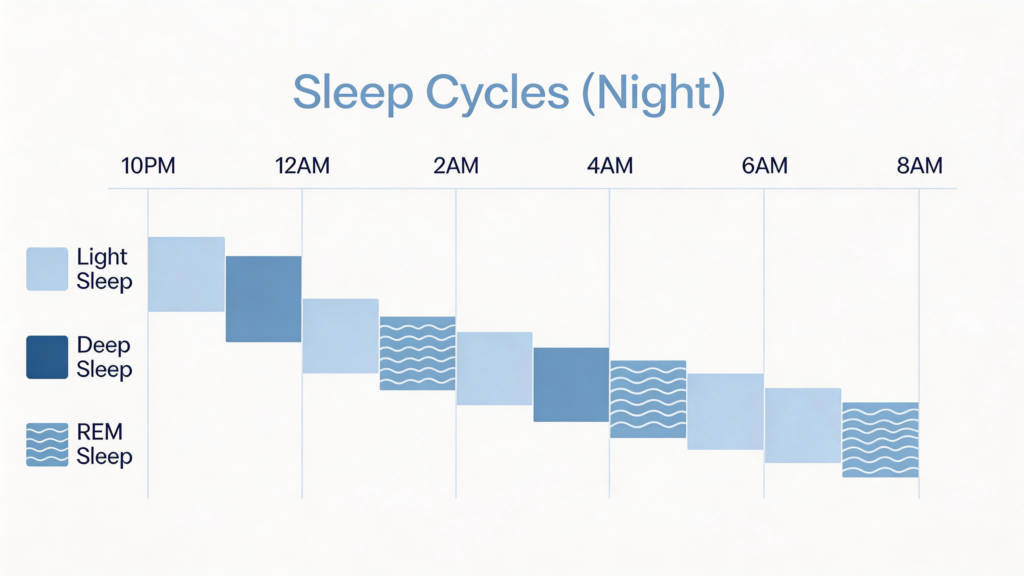 sleep trackers often undercount rem because they’re measuring movement and heart rate, not brainwaves. if your tracker says you got 45 minutes of rem, the actual amount might be somewhat higher. or not — it varies. the point is that trackers give you a rough signal, not a precise measurement, and obsessing over the exact number isn’t that useful.
what’s more useful is noticing how you feel. consistently waking up tired despite adequate sleep hours, struggling with mood, feeling mentally foggy — those are signs that sleep quality, including rem, might be the issue.
sleep trackers often undercount rem because they’re measuring movement and heart rate, not brainwaves. if your tracker says you got 45 minutes of rem, the actual amount might be somewhat higher. or not — it varies. the point is that trackers give you a rough signal, not a precise measurement, and obsessing over the exact number isn’t that useful.
what’s more useful is noticing how you feel. consistently waking up tired despite adequate sleep hours, struggling with mood, feeling mentally foggy — those are signs that sleep quality, including rem, might be the issue.
what suppresses rem sleep — the stuff worth knowing
before getting to what helps, it’s worth understanding what actually blocks rem. because a lot of people are inadvertently suppressing it without realizing it.alcohol
this is the big one. alcohol is sedating, which is why a drink before bed seems to help you fall asleep. but it significantly suppresses rem sleep, particularly in the first half of the night. as it metabolizes — usually 3 to 4 hours in — you often get a rebound effect where sleep becomes lighter and more fragmented. the result is that you sleep, but not well. the Sleep Foundation has documented this effect pretty clearly. even moderate amounts affect rem architecture.certain medications and supplements
some antidepressants — particularly SSRIs and SNRIs — are known rem suppressants. beta blockers too. some antihistamines used as sleep aids (diphenhydramine, the active ingredient in ZzzQuil or Benadryl) also blunt rem. if you’re on any of these and wondering why you feel unrested, it might be worth talking to a doctor about timing or alternatives. melatonin in high doses can also shift sleep architecture in ways that aren’t always beneficial. more on that below.sleep deprivation itself
here’s the thing — if you’re consistently not getting enough sleep, your body will try to make up for the deficit, but it prioritizes deep sleep first. rem comes later. so when you’re chronically short on sleep and then finally get a longer night, you might get a lot of deep sleep but still shortchange rem. it takes several nights of adequate sleep to really normalize rem patterns.waking up too early
because most rem happens in the last couple of hours of sleep, even a 30-minute difference in wake time can meaningfully affect how much rem you get. waking up at 6am versus 6:30am sounds small. in terms of rem, it’s not.how to get more rem sleep — what actually helps
protect the second half of your night
this is probably the highest-leverage thing on the list. since rem is concentrated in the 4am to 7am window, anything that disrupts sleep during those hours is cutting into rem specifically — not just sleep in general. that means: if you’re going to bed late and waking up early, you’re almost certainly rem-deficient. if you’re waking up at 3am and struggling to get back to sleep, that middle-of-the-night disruption is eating into your rem time. if that’s a pattern you recognize, the cortisol and 3am waking piece covers some of what’s often driving it. the practical implication: prioritize sleeping long enough, and protect the back end of your sleep window. that’s where the rem lives.cut or limit alcohol, especially close to bedtime
even one drink within 3 to 4 hours of sleep will affect your rem architecture. not catastrophically. but consistently. if you’re serious about improving rem, this is probably the first variable to look at.
keep a consistent sleep schedule
your body’s rem timing is tied to your circadian rhythm. when you go to bed and wake up at wildly different times — late on weekends, early on weekdays — your circadian rhythm can’t establish a stable pattern, and rem suffers. consistent timing is genuinely one of the most effective things you can do for sleep quality overall, including rem. it’s also one of the least exciting pieces of advice, which is maybe why it gets skipped. if your schedule is all over the place right now, the how to reset your sleep schedule article has a practical approach for getting back on track.manage stress and anxiety before bed
elevated cortisol at bedtime tends to keep you in lighter sleep stages and suppresses rem. the nervous system needs to be in a parasympathetic state — the rest-and-digest mode — for rem to unfold properly. if you’re lying in bed with your mind running, that’s a signal that cortisol is still elevated. things that genuinely help: a consistent wind-down routine, avoiding stimulating content in the hour before bed, keeping the room cool and dark. some people also find that magnesium glycinate taken before bed helps ease the nervous system down — there’s more on how that works in the magnesium for sleep and anxiety piece.be careful with sleep supplements
melatonin in low doses (0.5mg to 1mg) can help with sleep timing, particularly for jet lag or shift work. but higher doses — the 5mg and 10mg gummies that are everywhere now — can actually affect sleep architecture in ways that aren’t always beneficial for rem. if you’re using melatonin regularly and in higher doses, it might be worth dialing back and seeing if sleep quality changes.temperature matters more than people think
your core body temperature needs to drop to initiate and maintain sleep, and this is especially true for rem. a room that’s too warm tends to fragment sleep and push you into lighter stages. most sleep researchers point to somewhere around 65 to 68 degrees Fahrenheit as the range where sleep — and rem specifically — tends to be best. cooler than most people keep their bedrooms.don’t cut sleep short
worth saying plainly: the most reliable way to get more rem sleep is to sleep long enough and not interrupt the end of your sleep cycle. the last rem period before natural waking is often the longest and most restorative. if an alarm is waking you up mid-rem every morning, you’re cutting off the most important stage. if at all possible — not always realistic, but if possible — try to wake up naturally and see how much sleep you actually need.a note on sleep trackers and rem
if you’re trying to improve how to get more rem sleep and using a wearable to track it, some context is useful. consumer sleep trackers have gotten better, but they still have significant limitations in accurately staging sleep. they tend to overestimate light sleep and underestimate rem. a study in the Journal of Clinical Sleep Medicine found considerable variability between wearable sleep trackers and polysomnography, which is the actual clinical gold standard. this doesn’t mean trackers are useless — trends over time are more meaningful than any single night’s data. but if your tracker says you got 45 minutes of rem and you wake up feeling genuinely rested, the tracker might just be undercounting. how you feel is still the most useful signal.what to expect when you start improving rem
if you make meaningful changes — alcohol reduction, consistent schedule, stress management, protecting your sleep window — most people start noticing a difference within a week or two. not dramatically. it’s usually more like: waking up feeling a bit more rested, being slightly less reactive during the day, dreams being more vivid or memorable, that groggy-for-an-hour feeling in the morning gradually shortening. rem improvement is slow and cumulative. it’s not like taking something and waking up transformed. it’s more that you gradually build a pattern where your nervous system gets what it needs over several nights in a row, and the overall quality of your sleep shifts. that’s kind of how most sleep stuff works, honestly. the dramatic overnight fixes don’t really exist. the things that actually help are the boring ones — consistency, timing, cutting what suppresses it, giving your nervous system room to do what it’s trying to do.This article is for informational purposes only and does not constitute medical advice. Always consult a qualified healthcare professional before making changes to your health routine.