Passionflower may help some people with short-term sleep difficulties, but the evidence is limited. A few small human studies suggest possible improvements in sleep quality or total sleep time. They do not establish passionflower as a proven treatment for chronic insomnia, and different teas, extracts, and capsules cannot be assumed to have the same effect.
Passionflower products can also cause drowsiness, dizziness, or confusion and may not be appropriate during pregnancy, before surgery, or alongside medicines and substances that cause sedation. If you are considering it, the product, dose, other medicines, and reason for poor sleep all matter.
What is passionflower?
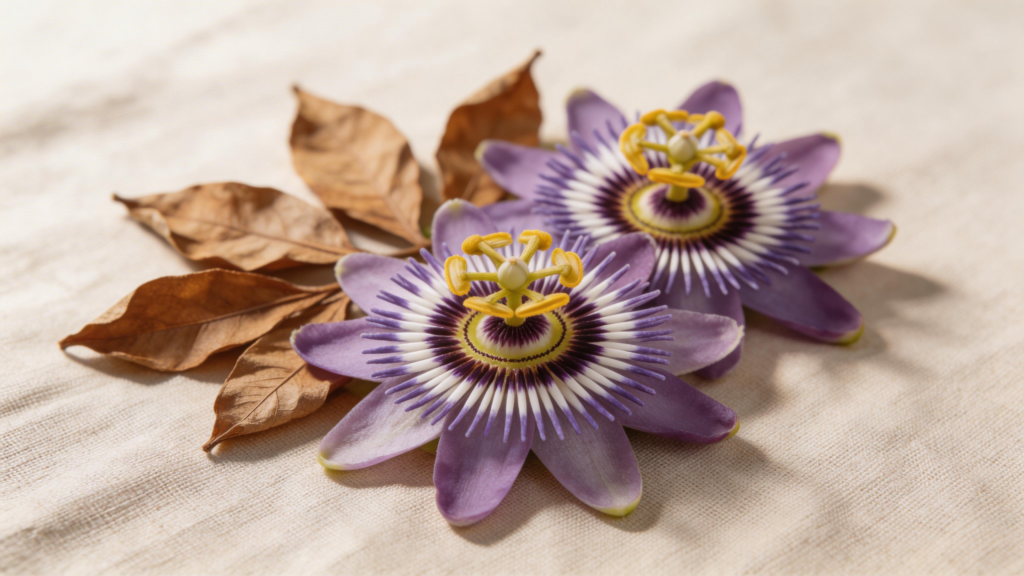
Passionflower is a group of flowering vines. The species most often used in herbal products for stress and sleep is Passiflora incarnata. Products may contain dried aerial parts of the plant as tea, powder, capsules, tablets, tinctures, or liquid extracts.
These forms are not interchangeable. An extract’s concentration depends on the plant material, extraction method, solvent, and manufacturing process. A milligram amount on one capsule therefore may not be equivalent to the same number on another product.
Passionflower has a long history of traditional use for mild mental stress and as a sleep aid. The European Medicines Agency recognizes this traditional use but notes that clinical studies have been too small or methodologically limited to support firm conclusions about effectiveness.
Does passionflower help with sleep?
The most accurate summary is promising but not proven.
Passionflower tea study
A 2011 double-blind, placebo-controlled study included 41 healthy adults. Participants drank passionflower tea or placebo tea for one week and rated their sleep. Sleep-quality ratings were better during the passionflower condition, but the study was small, brief, and relied mainly on self-reported outcomes.
This study supports further research. It does not show that passionflower reliably treats insomnia, nor does it establish that every commercial tea has the same contents as the study preparation.
Extract study in adults with insomnia
A 2020 randomized, placebo-controlled study evaluated a passionflower extract for two weeks in adults with insomnia disorder. The researchers reported a greater increase in total sleep time measured by polysomnography in the passionflower group, while several other sleep measures did not differ significantly. The sample was small, and the authors called for further research.
What reviews conclude
A systematic review of passionflower for neuropsychiatric conditions found signals of possible benefit but emphasized the limited number, size, and quality of clinical trials. The National Center for Complementary and Integrative Health similarly states that a small amount of research suggests possible effects on anxiety, while conclusions are not definite.
Claims that passionflower has been proved to increase deep sleep, works like a benzodiazepine without the risks, or treats the specific cause of “racing thoughts” go beyond the available evidence.
How might it work?
Laboratory and animal research suggests that compounds in passionflower may interact with the gamma-aminobutyric acid, or GABA, system. GABA is an inhibitory neurotransmitter involved in reducing neural activity.
However, a proposed mechanism is not proof of a meaningful clinical effect. Passionflower contains multiple compounds, and their amounts vary by species and preparation. It is not accurate to reduce the herb’s effect to one compound or to assume that it acts like a gentler version of a prescription sedative.
Forms and dosage
There is no single evidence-based passionflower dose for sleep that applies to every product. Clinical studies and traditional-use monographs have used different preparations, including:
- Tea made from dried Passiflora incarnata herb
- Dry extracts with different extraction ratios and solvents
- Liquid extracts and tinctures with different concentrations
Because concentrations vary, do not convert a study dose directly into drops, teaspoons, or capsules from an unrelated product. Follow the product label and do not exceed it. Look for a product that clearly identifies the species, plant part, extract ratio or concentration, serving size, and other active ingredients.
In the United States, dietary supplements are not approved by the Food and Drug Administration for effectiveness before sale. Independent quality testing can provide some information about identity and contamination, but a quality seal does not prove that a product improves sleep.
Tea, capsules, or tincture: is one form better?
There is not enough comparative research to say that one form is best.
Tea has the advantage of being the form used in the small 2011 sleep study, but commercial tea strength can vary. A caffeine-free warm drink and a consistent wind-down routine may also affect the experience independently of the herb.
Capsules and tablets are convenient, but the amount of raw herb and the amount of concentrated extract are not directly comparable. A blend containing valerian, melatonin, antihistamines, or other sedating ingredients makes it difficult to identify which ingredient caused an effect or side effect.
Tinctures and liquid extracts also vary in concentration and may contain alcohol. “Drops” are not a standardized dose across brands.
Side effects and safety
According to the National Center for Complementary and Integrative Health, possible side effects include drowsiness, dizziness, and confusion. Available safety research is mainly short term. NCCIH notes that passionflower tea may be safe for up to seven nights and daily extract use may be safe for up to eight weeks, but that does not establish long-term safety.
Do not drive, operate machinery, or perform another safety-sensitive activity if a product makes you drowsy or impaired. Stop using it and seek advice if you develop a concerning reaction.
Pregnancy and breastfeeding
Passionflower should not be used during pregnancy because it may induce uterine contractions. There is not enough reliable information to establish safety while breastfeeding. Discuss alternatives with a qualified healthcare professional.
Surgery and anesthesia
Passionflower may affect the central nervous system and could interact with anesthesia or medicines used around surgery. NCCIH advises that it may not be safe when taken before surgery. Tell the surgical team about every supplement you use and follow its instructions about when to stop.
Medicines, alcohol, and other sleep products
Combining passionflower with alcohol, prescription sleep medicines, benzodiazepines, opioids, sedating antihistamines, or other products that cause drowsiness may increase impairment. The absence of a documented interaction does not prove that a combination is safe.
Ask a pharmacist or prescriber before use if you take any medicine, especially one that affects alertness or the central nervous system. Do not replace prescribed treatment for anxiety or insomnia with passionflower without discussing the change with the clinician managing that treatment.
Children and adolescents
Do not give a child a passionflower sleep product based only on adult information or a traditional-use monograph. Product rules and age limits vary, and pediatric sleep problems require an age-appropriate assessment.
Should you combine passionflower with valerian, magnesium, or melatonin?
There is not enough evidence to recommend stacking passionflower with other sleep supplements. Combinations may increase drowsiness, introduce additional interactions, and make it impossible to know which ingredient caused a benefit or adverse effect.
Magnesium is not a proven universal sleep treatment, and restless sleep does not establish magnesium deficiency. Melatonin is mainly a signal involved in circadian timing and has specific uses; it is not interchangeable with an herbal sedative. Valerian also has uncertain evidence for insomnia and may add to sedation.
If a clinician considers a supplement reasonable, using one product at a time and documenting the result is more informative than starting a multi-ingredient blend.
How to evaluate whether it is helping
Do not rely on one unusually good or bad night. Before starting, record bedtime, estimated time to fall asleep, awakenings, wake time, daytime alertness, alcohol, caffeine, and other sleep products for several nights. Continue the same diary during any short trial.
Stop and reassess if there is no meaningful improvement, side effects occur, or you feel impaired the next day. Do not keep increasing the dose because a wearable still reports a low sleep score.
A supplement trial should not delay evaluation of the reason for poor sleep. Passionflower will not correct insufficient sleep opportunity, sleep apnea, restless legs syndrome, pain, reflux, medication effects, or a circadian-rhythm disorder.
When to seek medical advice
Speak with a healthcare professional before trying passionflower if you are pregnant or breastfeeding, take prescription medicines, use other sedating products, have a significant medical condition, or are preparing for surgery.
Seek an evaluation for sleep symptoms that persist, significantly impair daily life, or occur with:
- Loud snoring, witnessed breathing pauses, choking, or gasping
- Dangerous daytime sleepiness or drowsy driving
- An uncomfortable urge to move the legs at night
- Dream enactment, sleep attacks, or sudden muscle weakness
- Insomnia occurring at least three nights a week for three months or longer
Cognitive behavioral therapy for insomnia is the recommended initial treatment for chronic insomnia in adults and has stronger evidence than passionflower or other dietary supplements.
Frequently asked questions
How quickly does passionflower work for sleep?
Research does not establish a reliable onset time. Studies have evaluated a week of tea use or two weeks of extract use rather than proving that a dose works within a specific number of minutes. Product differences make precise timing claims unreliable.
Can passionflower treat anxiety-related insomnia?
Small studies suggest possible effects on anxiety and sleep, but there is not enough high-quality evidence to consider passionflower a treatment for an anxiety disorder or chronic insomnia. Persistent anxiety and insomnia deserve evidence-based assessment and care.
Is passionflower safer than melatonin?
They are different products with different uses and risks, so one cannot be declared universally safer. Safety depends on age, pregnancy, medical conditions, medicines, product quality, dose, and duration.
Can passionflower be used every night?
Long-term nightly safety has not been established. NCCIH’s safety summary is based on short periods of use. If you need a sleep aid every night or symptoms last more than a few weeks, investigate the cause instead of continuing indefinitely without clinical guidance.
Bottom line
Passionflower has a history of traditional use and a few small studies suggesting possible sleep benefits, but the evidence is not strong enough to call it a proven insomnia treatment. Product concentrations vary, and safety concerns include drowsiness, pregnancy, surgery, and additive effects with medicines or substances that cause sedation. Use cautious expectations, avoid supplement stacking, and seek appropriate care for persistent or severe sleep problems.
Sources
- National Center for Complementary and Integrative Health: Passionflower, Usefulness and Safety
- European Medicines Agency: Passiflorae herba
- Ngan and Conduit. A Double-Blind, Placebo-Controlled Investigation of the Effects of Passiflora incarnata Herbal Tea on Subjective Sleep Quality
- Lee et al. Effects of Passiflora incarnata on Polysomnographic Sleep Parameters in Subjects With Insomnia Disorder
- Janda et al. Passiflora incarnata in Neuropsychiatric Disorders: A Systematic Review
- American College of Physicians: Management of Chronic Insomnia Disorder in Adults
This article is for general educational purposes and is not a diagnosis or a substitute for care from a qualified healthcare professional.
Related sleep guides
- What the evidence says about chamomile tea
- Ashwagandha for sleep
- Magnesium forms for sleep and anxiety
- Glycine for sleep
This article is for informational purposes only and does not constitute medical advice. Always consult a qualified healthcare professional before making changes to your health routine.