

it’s 3:09am and I’m awake again
not groggy. not half-asleep. completely, stupidly, insultingly awake.
no alarm went off. nothing happened. I didn’t need the bathroom. one second I was asleep and the next I just… wasn’t. lying there in the dark with my heart doing this quiet fast thing, brain already running, already somewhere else entirely. already thinking about the email I didn’t send and whether I said the wrong thing at that thing last week and also, for some reason, a sandwich I had in 2016 that was really good.
I did this for over a year before I actually looked into why it kept happening. waking up at 3am — cortisol, specifically — didn’t make sense to me yet.I just thought I was a bad sleeper. a broken one. the kind of person who couldn’t even manage to stay unconscious correctly.
if the 3am thing has been going on for a while and you’re not sure where to start, I wrote something broader about why you keep waking up at 3am that might help give context first.
turns out there’s an actual reason. several, honestly. and understanding them didn’t immediately fix everything but it made 3am feel less like a personal failure and more like a thing that was happening for reasons. which helped more than I expected.
here’s what nobody tells you about cortisol
if you’ve been googling waking up at 3am cortisol on your phone in the dark same. here’s what I found.
cortisol isn’t just the stress hormone. I mean it is, kind of, but that framing makes it sound like it only shows up when something’s wrong. it doesn’t. it runs on a schedule.
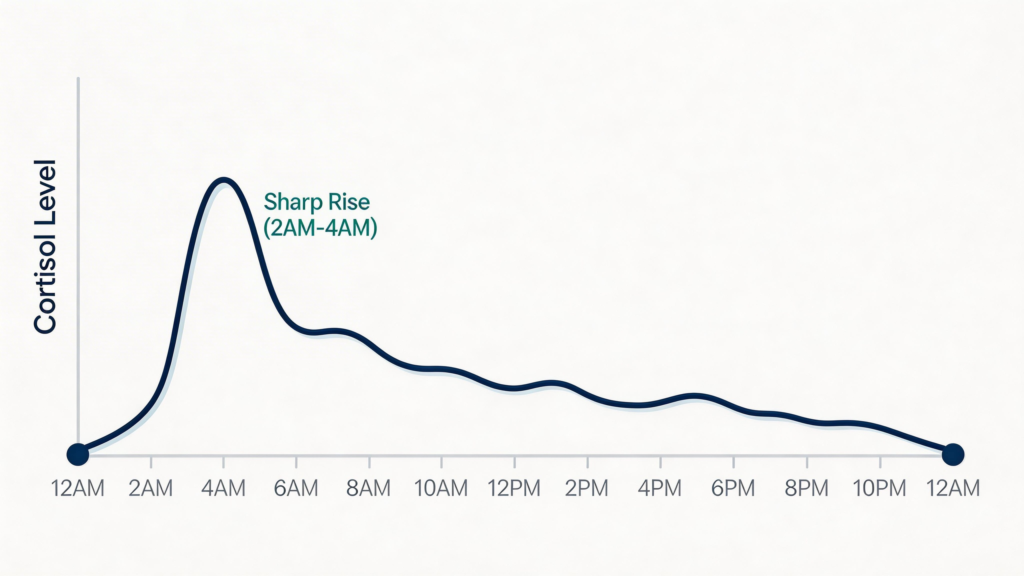
every single day, your cortisol levels follow a curve. they’re lowest in the first part of the night low enough that your body can actually do what it needs to do during deep sleep. then, somewhere around 2am to 4am, they start climbing. not because anything stressful is happening. just because morning is coming and your body is getting ready for it.
this is called the cortisol awakening response. the CAR. it’s your body’s prep sequence mobilizing blood sugar, organizing immune activity, telling your systems to get ready to be conscious and functioning. by the time your alarm actually goes off, cortisol has been rising for hours. you wake up because the body said so. not because you decided to.
when this works right, you don’t notice it. you sleep through the whole thing and open your eyes at 7am.
when it doesn’t work right, you open your eyes at 3am instead.
why 3am specifically, which feels like a cruel joke
sleep in the second half of the night is lighter. the first half is heavy long stretches of deep sleep, hard to wake from. but from about 2am onward, it shifts. more REM, less deep. you’re cycling through lighter stages, closer to the surface.
which means: if something nudges your cortisol into rising faster or sharper than it should, there’s not much sleep depth left to absorb it. you break through into wakefulness before you’re supposed to.
that’s why it’s 3am and not midnight. midnight you’re still in the deep end. 3am you’re already in the shallows, and cortisol is already climbing, and the gap between “asleep” and “awake” is about two degrees thinner than it should be.
all it takes is a little extra push. it’s the whole reason waking up at 3am and cortisol get talked about together the timing isn’t a coincidence.
the things that are probably giving it that push
chronic stress is the obvious one but let me be more specific than that because “reduce stress” is not useful advice at 3am.
when you’ve been running at high capacity for weeks big project, difficult relationship, financial anxiety, whatever your HPA axis recalibrates. the HPA axis is the system that actually controls cortisol production. hypothalamic-pituitary-adrenal. a chain of signals. and under sustained pressure, it gets sensitive. twitchy. the threshold for “release cortisol now” gets lower.
so instead of a gradual climb starting at 3am, you get a spike. and instead of sleeping through it, you wake up with your heart already going and your brain already running, and there’s nothing to point to. nothing happened. it’s just your nervous system, recalibrated to a hair trigger, doing what it’s been trained to do.
I want to tell you the blood sugar piece here because it’s the one that surprised me the most. when glucose drops low enough overnight and it can, especially if dinner was small or you had alcohol, which metabolizes and drops blood sugar as it clears your body treats it as a minor emergency. cortisol releases to tell the liver to push stored glucose out.
helpful system. except it wakes you up.
and the specific feeling of this one is different. there’s something hollow about it. a kind of shaky, vaguely anxious quality that doesn’t attach to a thought. you feel like you need something and you can’t figure out what. that’s probably the blood sugar piece. your body isn’t scared. it’s just trying to get the lights back on.
cortisol and blood sugar also loop. cortisol raises blood sugar. so if chronic stress is already keeping cortisol elevated, blood sugar regulation gets messier, overnight dips get less predictable, which triggers more cortisol, which makes things worse. it circles around on itself.
waking up at 3am cortisol hits differently depending on who you are
I want to say something specific about perimenopause because this one gets missed constantly.
estrogen and progesterone both have stabilizing effects on the stress response. as they decline and that decline starts earlier than most people realize, sometimes mid-thirties the HPA axis becomes more reactive. more like the chronic stress version, except it’s being driven by hormones shifting rather than anything in your circumstances.
women going through perimenopause often start waking between 2am and 4am with this anxious, heart-racing quality that doesn’t attach to anything. life is fine. nothing happened. but there it is. that’s not anxiety. that’s cortisol spiking through a less stable hormonal environment.
the night sweats and hot flashes that can come alongside it make things worse because now there’s also physical discomfort on top of an already-disrupted pattern.
sleep apnea does something similar in a way people don’t connect. if you’re stopping breathing repeatedly throughout the night, your body responds each time with a cortisol surge. you may not remember any of these micro-awakenings. but the cumulative cortisol effect by 3am can be enough to bring you fully awake. if the 3am thing comes with mornings that feel wrong heavy-headed, more tired than you should be worth mentioning to a doctor.

things that have actually helped me, fast and specific
the blood sugar one is where I’d start. small snack before bed, protein and slow carbohydrate, nothing big. some almond butter and a couple of crackers. a bit of cheese. something that gives the liver something to work with so cortisol doesn’t have to intervene. I resisted this for a long time because I’d been told eating before bed was bad. but the overnight fast is too long for some metabolisms. and once I started doing it, something shifted.
alcohol was the harder one. alcohol helps you fall asleep and then tanks your blood sugar as it clears, which is why you wake up at 3am feeling weirdly wired after a couple of drinks at dinner. I knew this intellectually before I actually tested it. cutting it out on weeknights made a difference I couldn’t argue with. I didn’t want it to work. it did.
there’s also a liver piece that connects to the 3am wake-up that I covered separately — waking up at 3am liver — because it overlaps with the blood sugar story in ways that surprised me.
morning light sounds embarrassing relative to the problem but I’m including it because the cortisol awakening response is anchored to your circadian rhythm which is anchored to light. if mornings are dark and evenings are bright screens, overhead lights, all of it the clock drifts. cortisol starts climbing at the wrong time. ten minutes of actual outdoor light within thirty minutes of waking, even on grey days, gives the circadian system the anchor it needs. I started doing this for other reasons and noticed the 3am thing quieting down a few weeks in. took me a while to connect the two.
if your schedule has drifted badly enough that morning light alone won’t cut it, this guide on how to reset your sleep schedule is worth reading alongside this.

phosphatidylserine is the supplement worth knowing about. not a sedative, not melatonin. it works at the level of the stress response itself, helping blunt the cortisol spike. there’s actual research behind it, around 400mg in the evening, give or take. it’s not magic but it has mechanistic plausibility in a way most sleep supplements don’t. talk to a doctor before starting it.
glycine is another one worth looking at for nighttime waking — different mechanism, but some people use it alongside the other changes.
one small thing
I started keeping a notebook by the bed. not for journaling. just for 3am.
and if the problem isn’t just the 3am wake-up but also why it takes so long to fall asleep in the first place — that’s a different but related thing.
when I wake up and the brain is already running the email, the thing I said, the vague dread with no object I write it down. not to process it. just to log it. to tell my nervous system: recorded, you can stop now, I have this.
it works. it’s annoying that it works. it works.
if the 3am waking has been happening for more than a few weeks and it’s affecting your days your concentration, your mood, the way you feel in your own body mention it to a doctor. there are cortisol tests, there are hormonal panels, there’s CBT-I which has better evidence behind it than sleep medication and effects that last. it’s more accessible now than it used to be.
don’t decide it’s not serious enough. it is serious enough.
waking up at 3am and cortisol being the reason doesn’t mean you’re broken. it means your body is doing something something real, on a schedule, for reasons and somewhere that schedule got pushed off. by stress, by blood sugar, by hormones shifting, by a circadian rhythm that drifted and nobody caught it.
all of those are fixable. not instantly. but fixable.
I still wake up at 3am sometimes. less often now. and I’ve read enough about waking up at 3am cortisol at this point to know that “less often” is actually the realistic goal, not never. and when I do, there’s something different about it less panic, less of that spinning “why is this happening” feeling. I know what’s happening. cortisol is climbing. the body is doing its prep sequence a little too early, a little too hard. it’s not a verdict.
I write the thing down. I do the breathing. sometimes I fall back asleep.
sometimes I don’t.
both are survivable.
This article is for informational purposes only and does not constitute medical advice. Always consult a qualified healthcare professional before making changes to your health routine.