
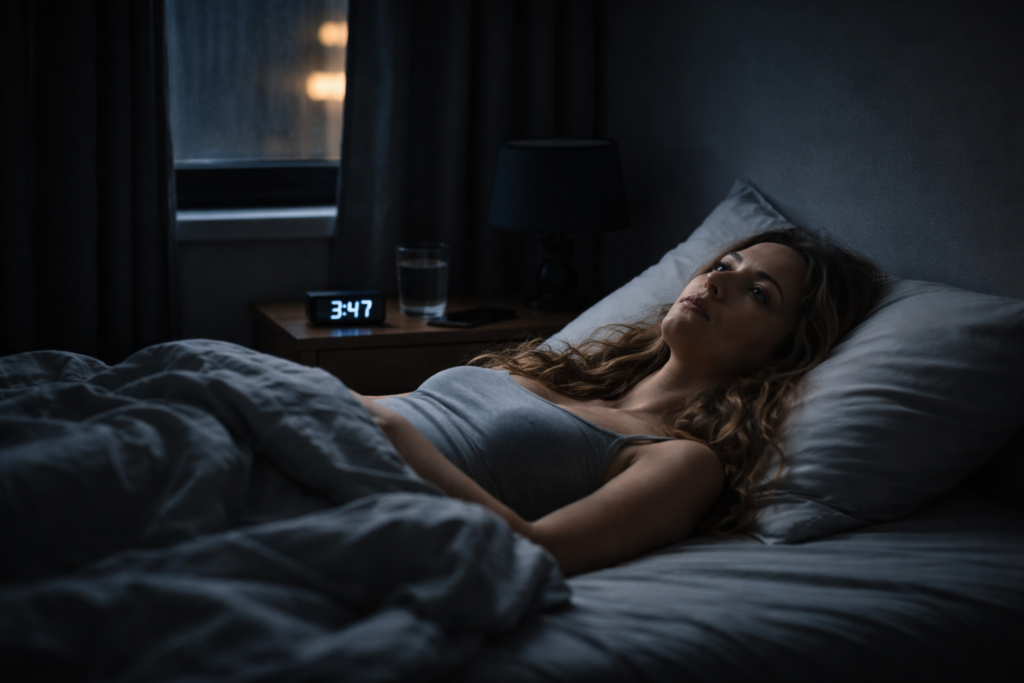
Three years of garbage sleep. That’s how long I spent being the person who falls asleep at 4 AM and wonders why life feels terrible.
Not by choice, obviously. I didn’t decide to become someone whose body thinks midnight is mid-afternoon. It just… happened. Remote work, a pandemic, a few “just one more episode” nights that slowly stretched into a lifestyle. Before I knew it, my sleep schedule was so wrecked that I genuinely couldn’t remember what it felt like to wake up and not immediately want to die.
I tried fixing it maybe four or five times. Each attempt went roughly the same way: white-knuckle an earlier bedtime for three days, crash hard on Saturday, sleep until 1 PM, start over from scratch. Rinse, repeat, feel terrible about yourself.
Every article I found about how to reset sleep schedule gave me the same useless advice. “Go to bed earlier.” “Avoid screens.” Cool. Super helpful. Thanks.
The Night I Actually Decided to Figure This Out For Real
It was a Tuesday. 3:47 AM. I was lying in my Brooklyn apartment staring at the water stain on my ceiling — which I’ve memorized at this point, intimately — and I’d been awake since 3:15. Not from a nightmare. Not from noise. Just that thing where your body decides, nope, we’re done sleeping now, for absolutely no reason.
I had a client call at 9 AM.
I did what any reasonable, chronically sleep-deprived person does: I opened my phone and started reading about why this keeps happening. Two hours later I’d gone from “3 AM insomnia” to a Japanese research paper about an amino acid called glycine, and I was taking notes. At 5 AM. Like a normal person.
The glycine thing caught my attention for a specific reason. Not because some wellness account recommended it — I’ve learned to distrust anything that comes with a discount code — but because the mechanism actually made sense to me. It felt like a real piece of the puzzle, not a shortcut. And at that point, I was desperate enough to try anything that didn’t involve just “going to bed earlier.”
Why Your Sleep Schedule Breaks in the First Place (The Version That Actually Explains It)
Okay so here’s what nobody explained to me properly until I started going down research rabbit holes at inappropriate hours.
Your body runs on a roughly 24-hour internal clock — circadian rhythm, you’ve probably heard of it. What I didn’t fully get was how physical this thing is. It’s not just “oh you’re a night person.” Your brain has this little cluster of neurons called the suprachiasmatic nucleus that’s basically acting as mission control, and it takes its orders primarily from light. Bright light in the morning tells it the day has started. Darkness tells it to release melatonin. When you’re staring at screens until 3 AM, you’re feeding it fake daylight signals for hours past when it should be shutting down.
Do that consistently for a few months and the whole hormonal sequence shifts. Melatonin onset moves later. Core body temperature drop moves later. Morning cortisol rise moves later. Your biology isn’t broken — it adapted to the signals you were giving it. Which is somehow worse, because it means you have to un-teach it.
And here’s the part that got me: you can’t just decide to go to bed at 11 PM and expect it to work. Your brain doesn’t know it’s supposed to be sleepy at 11 PM. You’ve trained it to expect alertness until 3 AM. You lie there in the dark feeling annoyingly awake and eventually give up and watch something, which confirms to your nervous system that yes, this is definitely wakeful hours, good call.
there’s a whole separate reason why it takes so long to fall asleep even when you’re genuinely exhausted — the nervous system just never got the signal that the day ended.
I did this cycle for like two years before I accepted that “trying harder to sleep earlier” was not the answer. If you’re actually trying to reset your sleep schedule — not just go to bed earlier for a few days and then crash — you have to work with your biology, not just willpower it.

The Actual Approach That Started Working
Two things, together. Not separately — together. That distinction matters.
The fixed wake time thing is not optional. I know everyone says this and it sounds boring and obvious. But I kept skipping it because it felt mean to myself. Wake up at 7:30 even if I fell asleep at 2 AM? That’s only five and a half hours. That’s brutal.
It’s also how it works.
Your circadian rhythm anchors itself to when you wake up, not when you go to sleep. Every morning you drag yourself up at the same time, you’re sending your body the same signal: day starts here. Over days, that signal accumulates. Your melatonin onset starts creeping earlier. You get tired at 11 PM instead of 2 AM. The wake time is the lever. This is actually the most important step when you’re trying to reset sleep schedule patterns that have been broken for months — the morning anchor is what pulls everything else into place.
I set mine at 7:30 and protected it like it was important. First few days felt like actual punishment. By day ten, I was getting genuinely sleepy by midnight. That had not happened to me in years.
The other non-negotiable: outside within thirty minutes of waking up. No sunglasses. Ten minutes minimum. This sounds absurdly simple and it is absurdly simple and it does an enormous amount of work. Morning light is the primary input for resetting your circadian clock — more powerful than any supplement, any sleep hack, anything. Your SCN needs to see outdoor-level light to confirm the day has started. Even a cloudy New York morning is way brighter than whatever you’ve got inside.
I started making coffee and walking to the end of my block and back. Twelve minutes. Changed things faster than I expected.
So Where Does Glycine Come In
Right, the whole point of this.
So while all this was happening — the fixed wake time, the morning walks, the genuinely depressing 1 PM caffeine cutoff — I still had this one specific problem. The 3 AM wake-up. Fall asleep fine, sleep solid for three hours, then pop awake and lie there for an hour with my brain fully operational and mildly panicking about nothing in particular.
The research I found pointed to something physical: in the early morning hours, your core body temperature naturally starts rising as your circadian system prepares you to wake up. For people with disrupted sleep architecture, that temperature shift can pull you out of deep sleep into a lighter stage where any small thing — a creak, a siren, your own thoughts — surfaces you completely.
Glycine, according to a study published in Sleep and Biological Rhythms, actually helps lower core body temperature when you take it before bed. Same direction your body wants to go when it falls asleep — just a small assist. The researchers found that participants fell into slow-wave sleep faster and reported less daytime fatigue. Small study, Japanese participants, worth noting. Not gospel. But the mechanism tracked.
I bought NOW Foods unflavored powder. Twelve bucks. Three grams dissolved in a little water, about forty minutes before I wanted to be asleep. Mildly sweet taste, nothing offensive.
What Thirty Days Actually Looked Like
Week one: nothing obvious. I almost stopped. Felt like expensive sugar water. If you try this and feel nothing in week one, that’s pretty normal — don’t bail.
Week two: this is when I noticed something. The 3 AM wake-ups didn’t stop, but I was getting back to sleep in fifteen or twenty minutes instead of lying there until 5 AM. That was new. That was a real change.
Week three and four: more consistent. The wake-ups got softer somehow — less snapping awake with the cortisol spike, more like surfacing and sinking back. Some mornings I actually felt rested. Not every morning. But enough that I noticed the two nights I forgot to take it. Those nights were worse. I don’t know how much of that is real effect versus my brain expecting it, honestly. Both? Probably both.
The thing I want to be clear about: glycine didn’t fix my sleep. What it did was smooth out one specific rough patch — that middle-of-the-night wake-up — while I was doing the actual work of resetting my sleep schedule. It made a hard process slightly less miserable. .That’s not nothing. But it’s not magic, and I’d be lying if I told you it was.
Other Stuff That Actually Moved the Needle
Caffeine cutoff at 1 PM. This hurt for five days and then genuinely changed my evenings. Caffeine’s half-life is five to six hours, which means the 3 PM cold brew is still about half-active in your bloodstream at 8 PM. I kept insisting it didn’t affect me. I was wrong about that.
Room temperature around 66–67°F. Cold enough that I need a blanket. Your body temperature needs to drop to initiate and maintain sleep — a warm room actively works against that process. This made a noticeable difference faster than I expected.
No food within two hours of bed. I resisted this one longest because I live in New York and eating dinner at 10 PM is basically a requirement for social survival here. But late eating sends “daytime” signals to your metabolic clock. Annoying. True.I also kept up the chamomile tea habit through all of this — it’s one of those things that layers well with the other changes.
The blue light glasses thing — look, maybe marginally useful. I wear them sometimes. I don’t think they’re doing much if you’re also on your phone until midnight. Treat them as a backup, not a solution.
What to Actually Expect, Week by Week
Week one of trying to how to reset sleep schedule for real: possibly worse than baseline. You’re sleep-deprived, your wake time is early, your body is confused and irritated. This is normal and it passes.
Week two: evening fatigue starts shifting earlier. You might catch yourself actually tired at midnight, which is either exciting or just kind of sad depending on your perspective.
Weeks three and four: the new schedule starts feeling like your schedule instead of a punishment. Mornings still aren’t fun, but they’re functional.
Relapses happen. I had a bad one during a stressful work stretch. The move is not to try to compensate with extra sleep — that just pushes your wake time later and you’re back to square one. Get up at your normal time the next morning even if it hurts. Reset from there.
Should You Try Glycine?
If the 2–4 AM wake-up window is your specific problem, genuinely yes, worth trying. Three grams, not ten — more is not better and can cause morning grogginess. Give it two full weeks before you decide it’s not working.
Don’t add it alongside five other new supplements at once. You won’t know what’s doing what and you’ll drive yourself insane.
But also — and I mean this — don’t take it and skip the boring infrastructure stuff. Fixed wake time. Morning light. Reasonable caffeine cutoff. Cool room. Those things are the actual mechanism for how to reset sleep schedule patterns that have calcified over months or years. Glycine is a useful assist while your clock is recalibrating. It is not a substitute for the recalibration itself.
If you’ve been running on four hours and three espressos for six months, please also just talk to a doctor at some point. Especially if you snore, gasp, or feel exhausted even after a full night. Some sleep issues are structural and no powder touches them.
Start with the wake time. Tonight, before you close this tab — pick a time. Set the alarm. Commit to it for two weeks.
It’s going to suck for a few days. That’s not a sign it’s not working. That’s just the gap between where your biology currently is and where you’re trying to move it.
You’re not broken. Your clock is just miscalibrated. Clocks can be reset.
And if you’re reading this at 3 AM because you woke up inexplicably and your brain is now fully online — hey. Me too, for a long time. It gets better. Promise.
Not a doctor, not a nutritionist. Just someone in Brooklyn who spent too long being exhausted and finally figured a few things out. If you’re on medication or dealing with a diagnosed sleep disorder, check with your doctor before trying anything new. Comments open if you’ve got a different experience with glycine — genuinely curious.
This article is for informational purposes only and does not constitute medical advice. Always consult a qualified healthcare professional before making changes to your health routine.