
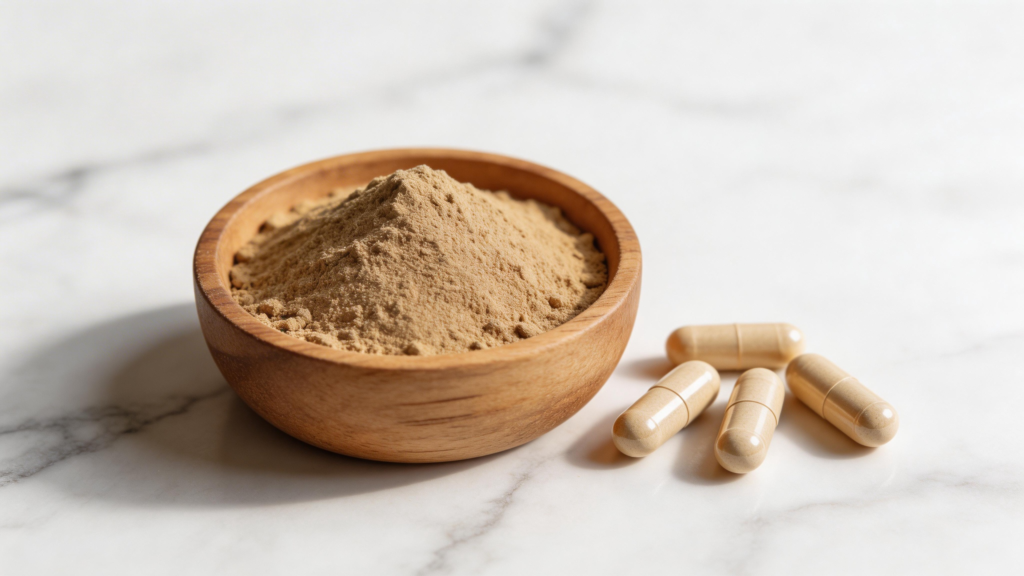
someone at work mentioned ashwagandha for sleep and I kind of half-listened. nodded. said “yeah I’ve heard of that.” I hadn’t really looked into it.
that was eight months ago. I’ve since looked into it quite a bit.
here’s what I found — including the stuff that’s actually backed by research, and the parts where I think the wellness crowd overpromises it.
what even is ashwagandha
it’s a root. been used in Ayurvedic medicine for something like 3,000 years. the scientific name is Withania somnifera — and somnifera comes from Latin, means “sleep-inducing.” so the sleep connection isn’t some recent wellness invention. it’s literally in the name. has been for centuries.
also called Indian ginseng. winter cherry. apparently the roots smell like a horse — “ashwa” means horse in Sanskrit, “gandha” means smell. genuinely did not need to know that. now you do too.
the active compounds are called withanolides, mostly found in the root. most of the clinical research used standardized extracts — specific branded versions like KSM-66 or Sensoril — not just generic root powder from whatever bulk supplier. that distinction matters more than most product labels acknowledge.
it’s also classified as an adaptogen, which is a real category but a loose one. the basic idea: helps the body resist stress in a general, non-specific way. and since chronic stress is one of the main things that wrecks sleep — elevated cortisol, a nervous system that refuses to settle — the theory is that if ashwagandha genuinely dials that down, better sleep follows as a kind of side effect. whether that actually happens in practice is exactly what I wanted to figure out.
5 things the research shows about ashwagandha for sleep
this is where I stopped being skeptical.
there’s a 2021 meta-analysis in PLOS ONE that pulled together five randomized controlled trials — 400 participants total. the finding: ashwagandha had a small but statistically significant effect on overall sleep quality. not dramatic. but real, and consistent across every study they looked at.
what specifically improved? sleep onset latency came down — people fell asleep faster. total sleep time went up. sleep efficiency improved. wake after sleep onset decreased. that last one is the waking up in the middle of the night thing, which anyone dealing with stress-driven sleep problems will recognize immediately.
there’s also a 2019 trial on PMC worth looking at. insomnia patients, 300mg of ashwagandha root extract twice a day, ten weeks. sleep onset latency dropped significantly. sleep efficiency went from around 75% up to 83%. for people who spend a lot of time lying awake staring at the ceiling — 75% efficiency is actually pretty common and pretty miserable — that kind of shift feels noticeable in daily life.
a 2020 study on PubMed looked at both healthy adults and insomnia patients across eight weeks. both groups improved. but here’s the part that stuck with me — effects were stronger in people who already had sleep problems. which suggests ashwagandha might be more useful when something is genuinely dysregulated, not just for the occasional rough night.
the consistent pattern across trials: results are more reliable at 600mg per day or higher, taken for at least eight weeks. lower doses, shorter windows — less consistent. worth keeping in mind when someone says they “tried it for two weeks and nothing happened.”
why does it help — the mechanisms, best guess
nobody has fully figured this out yet. but a few pathways keep coming up.
the cortisol piece is the most consistently documented thing. multiple studies show ashwagandha lowers serum cortisol in people under stress. and cortisol at night is — well, it’s the wrong hormone entirely. it’s the one that’s supposed to be low when you’re trying to sleep. if you’re someone who keeps waking up at 3am and cortisol is part of the picture, this is directly relevant.
there’s also animal research pointing to withanolides interacting with GABA receptors — the same inhibitory receptors that sleep medications target. GABA is essentially the nervous system’s off switch. whether that translates cleanly to humans at normal supplement doses, still being studied. but it’s a plausible reason for the sleep onset improvements people keep reporting.
and then there’s the anxiety angle, which is probably the most practically relevant piece for a lot of people. a 2021 NIH systematic review found ashwagandha significantly reduced stress and anxiety scores across multiple trials. and if you’re lying awake because your brain won’t stop running — which is exactly what happens when it takes you ages to fall asleep — anxiety relief and sleep improvement end up being the same problem.
it’s not a sedative. it doesn’t push you toward sleep. it removes some of what’s in the way.
dosage — what the studies actually used
300 to 600mg of standardized root extract per day is what comes up most consistently across trials. some studies split it — 300mg in the morning, 300mg in the evening. others used a single 600mg dose. hard to say definitively which is better. the split approach keeps levels more stable throughout the day, which might matter given cortisol moves around a lot across 24 hours.
taking some of it before bed makes sense. an hour before sleep is the common recommendation — not because it’ll knock you out, it won’t, but because the anxiety-quieting effect might smooth out the transition into sleep if it’s working. 
the eight-week thing is genuinely important and I think gets glossed over. most people who “tried ashwagandha and it didn’t work” probably gave it two or three weeks. the studies showing the strongest effects were at six to eight weeks. it’s a slow build. if you’re going to try it, you have to actually commit to trying it long enough to find out.
KSM-66 vs Sensoril vs regular powder — does the form matter
more than most people realize.
the clinical research is built almost entirely on standardized extracts. KSM-66 is full-spectrum root extract, standardized to at least 5% withanolides — it’s the most researched form, shows up in most of the bigger trials. Sensoril is root-and-leaf, higher withanolide concentration, usually dosed lower at 125–250mg. both appear consistently in the literature.
plain root powder with no standardization info? might work. might not. the dose number on the label doesn’t mean much if you don’t know the withanolide content, because that’s what’s actually doing the work.
neither form clearly beats the other for everyone. but if a product doesn’t mention KSM-66, Sensoril, or any withanolide percentage — that’s worth noticing before you buy.
who is this actually going to help
stress-driven sleep problems. that’s the clearest answer from the research.
not everyone’s insomnia is the same thing. some people have cortisol spikes pulling them awake at 3am. some have trouble at sleep onset. some have a completely disrupted schedule. ashwagandha’s mechanism — cortisol reduction, anxiety relief — makes it more relevant for certain patterns than others.
if your sleep reliably falls apart during stressful periods, if you lie awake running mental loops about tomorrow, if you notice a clear link between your stress levels and your sleep quality — that’s the profile where ashwagandha keeps showing up in the literature.
if it’s more physical — sleep apnea, pain, waking up to use the bathroom, actual circadian disruption from shift work — it’s probably not the right tool. it doesn’t fix those things.
it can layer on top of other approaches rather than replace them. if you’re already working on resetting a disrupted sleep schedule or figuring out why falling asleep takes so long, ashwagandha might support that without conflicting. it’s not a standalone fix. more like a supporting piece.
side effects and safety — what to know before starting
generally considered safe for short-term use. in most clinical trials no significant adverse events came up. the side effects that do appear tend to be mild — upset stomach, loose stools, some nausea if taken on an empty stomach, occasional drowsiness. taking it with food mostly fixes the digestive stuff.
a few things worth knowing:
- liver: rare case reports exist linking ashwagandha to liver injury. uncommon, but worth noting if you’re on other medications or have any liver history.
- thyroid: may influence thyroid hormone levels. check with a doctor first if you have a thyroid condition or take thyroid medication.
- pregnancy: not recommended. avoid entirely.
- long-term use: most trials only go to about three months. safety beyond that window isn’t well-established yet.
the NIH Office of Dietary Supplements says it appears safe for up to three months based on current evidence, but recommends checking with a healthcare provider first — especially if you’re on medications.
how to actually take it
if you want to give it a real shot — as in, one that matches what the research actually tested — here’s what that looks like:
- pick a standardized extract. KSM-66 or Sensoril on the label, or at minimum a stated withanolide percentage.
- start at 300mg per day for the first week or two. with food.
- work up to 300mg twice daily or a single 600mg dose if the lower amount sits fine.
- take part of the dose in the evening, roughly an hour before bed.
- give it at least six weeks. eight is better. most people who quit early quit before anything would have shown up anyway.
- don’t expect to feel it kick in. it’s not sedating. the signal is more like — over several weeks, sleep starts getting a bit easier. less time lying awake. waking up feeling slightly less wrecked. subtle, but cumulative.
how it compares to other sleep supplements
different tools for different problems.
melatonin is for circadian timing — jet lag, shift work, resetting a schedule that’s gone sideways. doesn’t do much for stress-driven insomnia. wrong mechanism. ashwagandha doesn’t touch circadian timing but does target the stress-anxiety axis. they’re solving different things.
magnesium — muscle relaxation, GABA activity, reasonable evidence for sleep quality. pairs fine with ashwagandha. they’re not working against each other.
glycine lowers core body temperature, helps with sleep onset specifically. totally different mechanism. gentle, well-tolerated.
ashwagandha’s lane is specifically: stress, cortisol, a nervous system that won’t wind down. if that matches what’s actually going wrong with your sleep, it’s one of the more research-backed natural options out there. if it doesn’t match, something else is probably a better starting point.
the bottom line
ashwagandha for sleep isn’t hype. there are real trials — randomized, placebo-controlled, using objective sleep measurement — showing consistent if modest improvements in sleep onset, total sleep time, and staying asleep through the night.
it’s not a sedative. it doesn’t knock you out. what it seems to do is remove some of the background interference — cortisol comes down, anxiety quiets, sleep becomes a bit less of a fight. for people whose sleep problems have a clear stress or anxiety component, that’s genuinely useful.
for everyone else, it might just be the wrong tool entirely.
worth trying? I think so, for the right person. just don’t expect it to work in week one.
Related reading: If you are comparing herbal options, review the evidence, dosage limits, and interactions for passionflower for sleep.
This article is for informational purposes only and does not constitute medical advice. Always consult a qualified healthcare professional before making changes to your health routine.