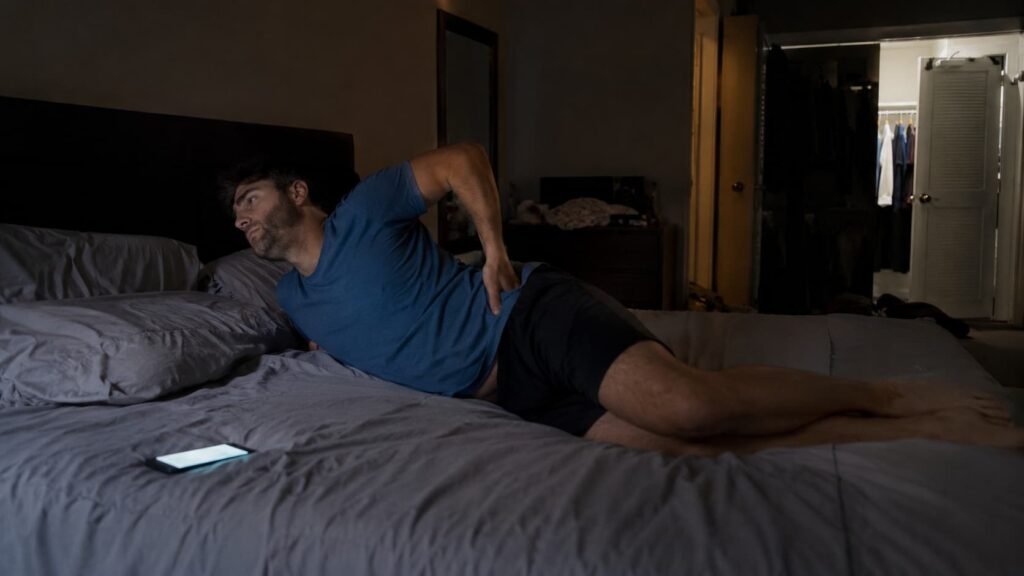
not in a cool way. not in a “I lifted something heavy and now I have a story” way.
more like you sat weird for too long, carried groceries on one side, bent over the sink brushing your teeth, and now your spine has decided to become a whole personality.
and of course it gets louder at night.
because why wouldn’t it.
you get into bed thinking sleep will fix things. then your lower back immediately says no. side feels wrong. back feels too flat. stomach sleeping feels like something you should not be doing but somehow keep doing anyway.
then you do that slow roll.
the careful one.
the one where you move like your body is made of old glass.
and somewhere around 12:47am you search best sleeping position for lower back pain because apparently this is your evening now.
the answer I hate is also the answer I keep coming back to:
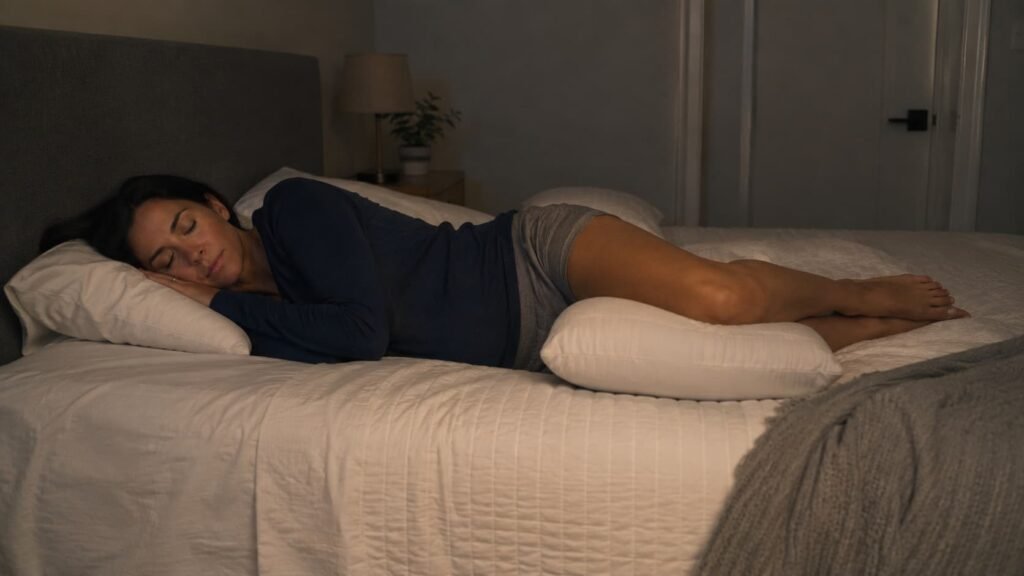
if you sleep on your side, put a pillow between your knees.
if you sleep on your back, put a pillow under your knees.
that’s the main thing.
deeply unglamorous.
unfortunately useful.
the side sleeping problem nobody notices while it’s happening
side sleeping sounds safe.
it sounds like the reasonable choice. you’re not on your stomach doing neck crimes. you’re not flat on your back wondering if your lower spine is hovering in midair.
but side sleeping can still mess with your lower back.
the sneaky part is your top leg.
it falls forward.
just a little.
your pelvis follows. your lower back twists. not some huge dramatic twist. just enough that you wake up the next morning stiff and annoyed and weirdly suspicious of your mattress.
I ignored this for a long time because “put a pillow between your knees” sounded too simple. like advice printed on a beige pamphlet in a waiting room.
but the pillow is doing a job.
it keeps your knees separated. it keeps your hips more stacked. it stops the top leg from dragging your lower back into a small overnight argument.
Mayo Clinic says side sleepers can draw the legs up slightly and place a pillow between them to reduce strain on the back.
that is the calm version.
my version is: your top knee is not innocent.
use a regular pillow first. don’t panic-buy the special knee pillow at 1am unless you enjoy making decisions while desperate.
if the pillow goes flat, use a firmer one.
if your top shoulder collapses forward, hug another pillow.
yes, it looks a little dramatic.
it’s fine.
the room is dark. nobody is reviewing your technique.
don’t curl into a tiny emergency shape
there is a version of side sleeping where you curl up so tightly you basically become punctuation.
I understand it emotionally.
physically, maybe not.
a gentle curl can feel good. knees slightly bent. pillow between them. back not twisted. that’s fine.
but if you pull your knees way up and round everything in, your hips can get stiff, your lower back can feel locked, and morning becomes this slow unfolding process.
like trying to open a chair that has been stored in a garage for six years.
soft bend.
not panic ball.
unless emotionally. then, sure. but give your back some space.
——
back sleeping only works if the knees are not just lying there doing nothing
back sleeping looks correct.
flat body. face up. very adult. very “I know where my insurance card is.”
but my lower back does not always enjoy it.
without support, that curve in the low back can feel tense. not sharp pain necessarily. more like the muscles are staying awake to supervise the situation.
which is rude, because I am trying to sleep.
putting a pillow under the knees changes the angle a little. your knees bend. your pelvis settles. your lower back doesn’t have to arch as much.
it is not magic.
it is just less annoying.
Cleveland Clinic mentions that a small pillow under the knees can help work with the spine’s natural curve and reduce lower-back pressure.
again. boring. suspiciously effective.
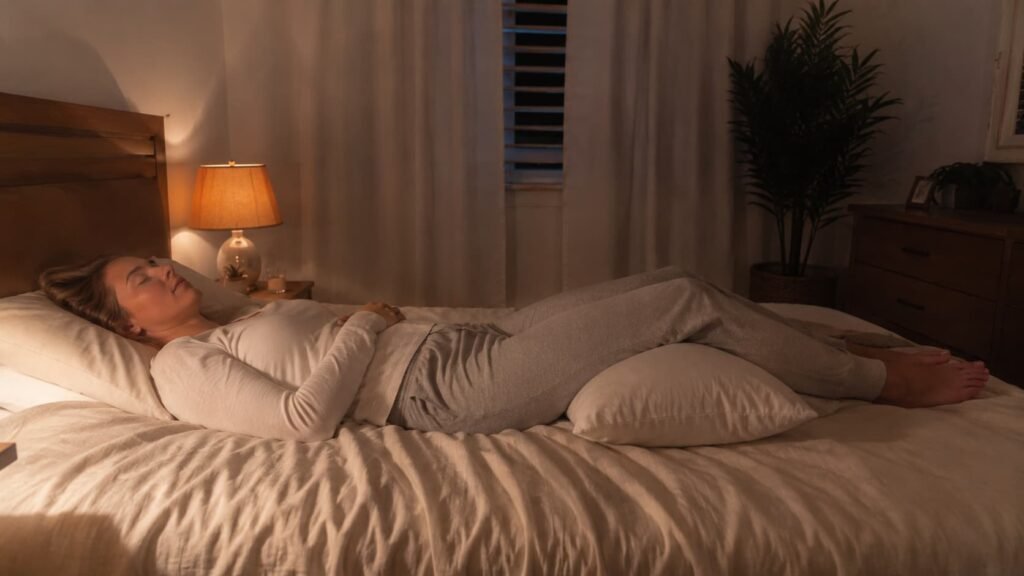
don’t make a mountain. one pillow. maybe a folded blanket. enough to soften the knees, not enough to turn your bed into a physical therapy display.
also: if back sleeping makes you snore badly or you deal with sleep apnea, this may not be your best option. I’d be careful there. That connects with this piece: best sleep position for sleep apnea.
same bed.
different problem.
still annoying.
stomach sleeping. yeah, sorry.
stomach sleepers are loyal.
I’ll give you that.
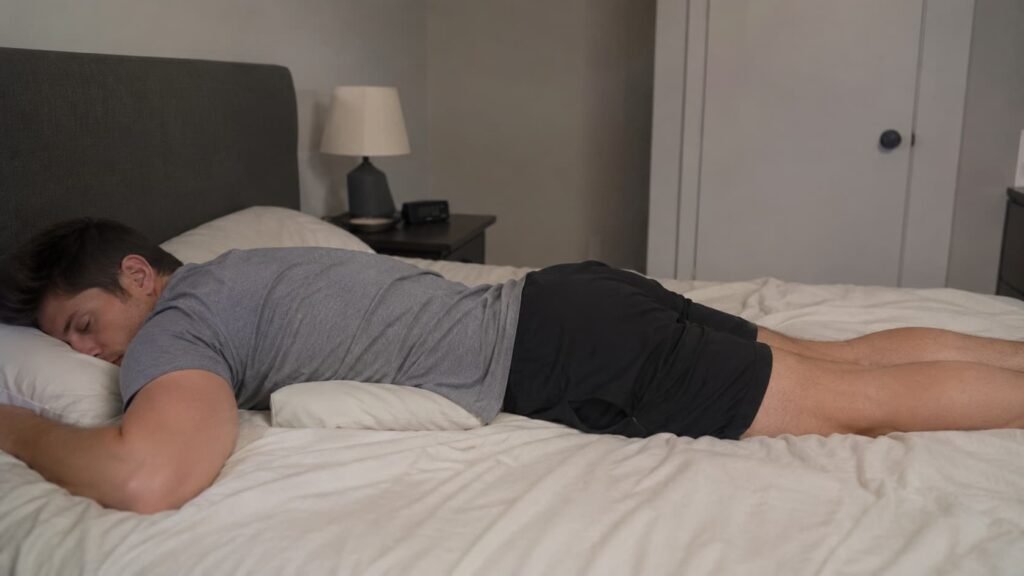
but stomach sleeping can be rough on lower back pain. your lower back often arches more. your neck has to turn sideways because breathing face-down into a pillow is not ideal, apparently. then the shoulder gets involved. maybe the hip too. everyone has feedback.
if you cannot quit stomach sleeping, try making it less bad.
thin pillow under the hips or lower belly.
very thin pillow under the head.
or no head pillow, if your neck is okay with that.
not perfect.
less bad.
some nights that is the entire achievement.
the mattress might be guilty, but I hate making this about mattresses
mattress advice always starts sounding like a sales pitch.
medium-firm support. cooling layers. pressure relief. engineered comfort.
please.
but yes, the mattress can be part of it.
if it’s too soft, your hips may sink and pull your spine out of line. if it’s too hard, your hips and shoulders may not sink enough. if there’s a dip in the middle, congratulations, your bed has developed a personal canyon.
before buying anything, do the cheap experiments.
rotate the mattress.
sleep on the other side for a night.
try a topper if it feels too hard.
try a firmer surface for one night if your hips feel like they’re sinking into soup.
none of this is elegant.
but lower back pain is not exactly an elegant topic.
Sleep Foundation notes that sleep position and mattress support can both affect lower back pain. which is obvious in the way useful things are often obvious after you’ve ignored them for years.
the head pillow is somehow part of this too
unfair, honestly.
we are here for lower back pain. why is the head pillow speaking.
because the spine is connected and dramatic.
if your pillow is too low when you side sleep, your head drops. too high, your neck bends up. then your shoulders tense. then your back joins the meeting.
I hate meetings.
side sleepers usually need a thicker pillow than back sleepers. back sleepers usually need something lower. stomach sleepers need almost nothing, which feels like another strike against stomach sleeping.
you don’t need perfect alignment.
just less crooked.
what I’d actually try tonight
not a routine.
I refuse to call everything a routine.
- side sleeper: pillow between the knees
- back sleeper: pillow under the knees
- stomach sleeper: thin pillow under the hips
- head pillow that does not bend your neck into regret
- mattress that is not actively swallowing you
then stop adjusting for a second.
seriously.
lie there long enough to feel if the position gets calmer or worse. if it gets worse fast, don’t force it because some article used the word “best.”
your body is allowed to disagree.
irritating, but allowed.
in the morning, notice the small stuff. did you stand up with less stiffness? did you make fewer little involuntary sounds? did your lower back feel less like it spent the night holding a grudge?
small counts.
small is usually where this starts.
when this is not a pillow problem
most lower back pain is not an emergency.
but some things are not bedtime-hack territory.
if pain shoots down your leg, or you have numbness, weakness, fever, unexplained weight loss, pain after a fall, or trouble controlling your bladder or bowels, get medical help.
don’t keep rearranging pillows like the answer is hiding under the comforter.
also, if the pain keeps coming back every night or keeps getting worse, a physical therapist may be more useful than another midnight experiment.
less fun.
probably more useful.
Cleveland Clinic points out that morning lower back pain can come from sleep position, mattress issues, staying still, or underlying conditions.
which is helpful.
also very “could be anything.”
classic body behavior.
related sleep mess
lower back pain does not stay politely in one category.
it messes with sleep. bad sleep makes pain feel louder. then bedtime starts feeling like a negotiation. then your body tenses before you even lie down.
great system. no notes.
if this is part of a bigger sleep mess, these fit naturally:
- back problems sleeping
- shoulder problems sleeping position
- neck problems sleeping
- waking up tired after sleeping 8 hours
not everything is connected.
but sleep loves dragging every problem into the same room.
FAQ
what is the best sleeping position for lower back pain?
for a lot of people, side sleeping with a pillow between the knees is the easiest place to start. back sleeping with a pillow under the knees can also help. the point is less twisting, less arching, less overnight back drama.
is side sleeping good for lower back pain?
yes, if your hips are supported. without a pillow between the knees, your top leg can fall forward and twist your lower back.
is back sleeping better?
sometimes. back sleeping with a pillow under the knees can reduce lower-back pressure. but if back sleeping makes snoring or sleep apnea worse, side sleeping may be better.
is stomach sleeping bad for lower back pain?
it can be. stomach sleeping often increases the lower back arch and twists the neck. if you can’t stop, try a thin pillow under your hips.
why does my lower back hurt more in the morning?
could be sleep position. could be the mattress. could be stiffness from not moving. could be an actual back issue. if it keeps happening or gets worse, get it checked.
the bit I’d keep
side sleeper?
pillow between the knees.
back sleeper?
pillow under the knees.
stomach sleeper?
I’m sorry. thin pillow under the hips. maybe consider switching one day when you have the emotional strength.
the best sleeping position for lower back pain is not the one that looks perfect in a diagram.
it’s the one where your lower back stops twisting, sagging, or bracing all night.
start there.
then see how rude your back is in the morning.
This article is for informational purposes only and does not constitute medical advice. Always consult a qualified healthcare professional before making changes to your health routine.