
finding the best sleeping position for sinus drainage is one of those things you only start caring about at 2am, when you’re lying flat on your back and your sinuses have decided to stage some kind of internal protest.
everything drains the wrong way. you can feel it — that slow pressure buildup behind your eyes, the thickness at the back of your throat, the specific kind of congestion that makes breathing through your nose feel like a suggestion rather than a given. you flip to one side. slightly better. you flip to the other. worse, actually. you stack another pillow. unclear if that helped or if you’ve just created a new problem for your neck.
there’s a reason certain positions make sinus congestion dramatically worse overnight. and there’s a reason other positions — small adjustments, nothing dramatic — change how you feel when you wake up. it has to do with gravity, pressure, and the fact that your sinuses are doing continuous maintenance work whether you’re awake or not.
here’s what’s actually happening, and what to do about it.
why sleep position affects sinus drainage at all
your sinuses — the hollow spaces behind your cheeks, forehead, and nose — produce mucus continuously. that mucus is supposed to drain downward and out through the nasal passages. gravity helps. when you’re upright, drainage happens mostly without you noticing.
when you lie down, everything changes. the drainage angle shifts, gravity stops helping as efficiently, and mucus that would normally clear itself starts pooling. if you’re already congested — from a cold, allergies, sinusitis, dry air, whatever — that pooling makes congestion worse overnight. it also creates pressure. and it’s why people with sinus issues often feel significantly worse in the morning than they did when they went to bed.
the other issue is inflammation. when you lie flat, blood flow to the nasal passages increases slightly, which can cause the tissue lining the sinuses to swell. that swelling narrows the drainage pathways further. it’s a feedback loop: congestion makes drainage harder, poor drainage increases pressure, pressure makes congestion worse, and you wake up feeling like your head is full of cement.
which position you sleep in either works with those mechanics or against them.
the best sleeping position for sinus drainage
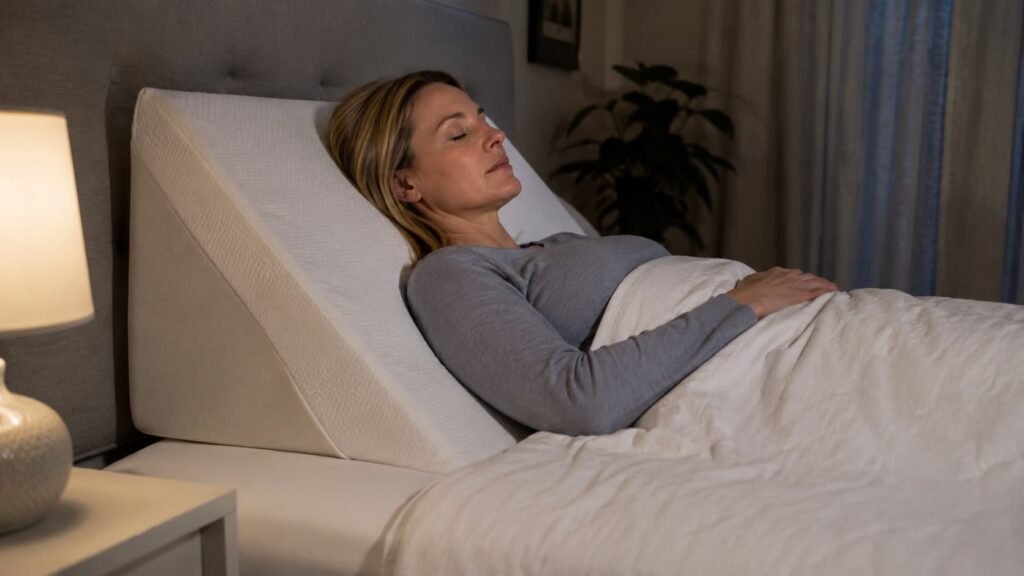
head elevated, on your back. that’s the position that works best for most people with sinus drainage issues, and the mechanics are straightforward: elevation keeps the sinuses above the nasal passages, which means gravity is still working in your favor even while you’re horizontal. mucus drains down and out rather than pooling behind your cheekbones and forehead.
the elevation needs to be meaningful — not just an extra pillow folded in half that collapses by midnight. a wedge pillow is the reliable option here. something that holds a consistent angle of around 30 to 45 degrees through the whole night. that angle is enough to keep drainage moving without being so steep that you slide down or put strain on your neck.
if you don’t have a wedge pillow, stack two firm pillows — not soft ones — and make sure they’re supporting your head and shoulders, not just your head. if only your head is elevated and your shoulders are flat, you create a kink at the neck that’s both uncomfortable and partially undoes the drainage benefit. the elevation needs to start at the shoulders.
side sleeping: which side matters
if back sleeping isn’t working for you — or if you’re someone who simply cannot stay on their back through the night — side sleeping with elevation is the next best option. but the side you choose matters more than you’d think.
whichever side is down tends to get more congested. this is just physics — increased blood flow to the lower side, drainage pathway narrows, that nostril blocks up. most people with sinus issues who sleep on their side notice this without knowing why: one side of their nose is clear and the other is blocked, and it corresponds almost exactly to which side they were lying on. 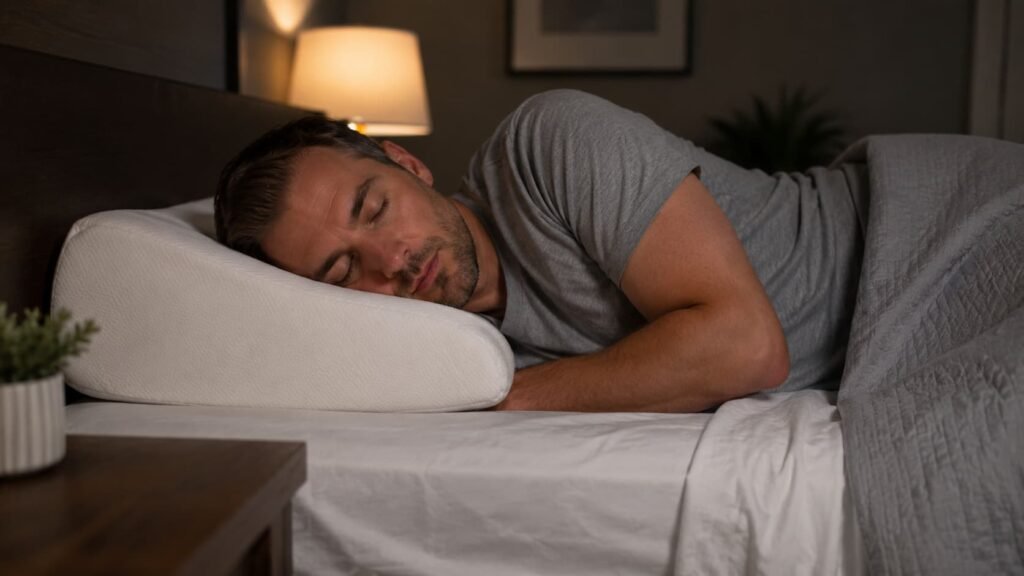
the practical implication: if your congestion or sinusitis is worse on one side, sleep on the opposite side. if it’s roughly equal, sleep on whichever side feels clearer — or switch sides during the night when one nostril blocks up, which your body will probably prompt you to do anyway.
side sleeping still benefits from elevation. a pillow that keeps your head slightly above your shoulders — not just neutral — helps drainage even in the lateral position. this is another argument for a wedge pillow if sinus issues are a recurring thing for you, not just an occasional cold.
what to stop doing
sleeping completely flat on your back. no elevation. this is the position that most reliably makes sinus congestion worse overnight. the sinuses sit level with or above the drainage passages, mucus pools, pressure builds, and you wake up with that specific heavy-headed feeling that takes half the morning to shake off. if you’ve been doing this and wondering why your sinuses are always worst first thing — this is probably why.
sleeping face-down. stomach sleeping puts your face at an angle where sinus drainage is working against gravity. one or both sinuses end up in a position where mucus has nowhere useful to go. there’s also the neck rotation issue — most stomach sleepers turn their head to one side, which compresses one side of the nasal passage further. it’s the worst position for sinus drainage by a reasonable margin.
sleeping on the congested side. if one side of your sinuses is significantly more blocked than the other, lying on that side increases blood flow to the already-inflamed tissue and makes it worse. this one is almost immediately noticeable if you pay attention to it — lie on the bad side for twenty minutes and the congestion on that side gets measurably worse.
things to do before bed that actually help
a saline rinse or nasal spray before lying down. this is probably the single most effective pre-sleep intervention for sinus congestion — it flushes out the mucus that’s already built up during the day, reduces inflammation in the nasal lining, and gives you a clearer starting point before you ask your sinuses to drain overnight. a neti pot or a saline squeeze bottle, done ten to fifteen minutes before bed, changes the overnight experience significantly for most people who try it. 
a humidifier in the bedroom. dry air thickens mucus and makes it harder to drain. if you live somewhere with dry winters, or if your heating system dries out the air significantly, running a cool-mist humidifier while you sleep keeps the mucus thin enough to move. the difference is most noticeable in the morning — that thick stuck feeling on waking is often partly a dry-air problem, not just a congestion problem.
a warm shower before bed. the steam helps loosen congestion and opens the nasal passages temporarily. not a permanent fix, but if you’re trying to get to sleep while congested, ten minutes of steam followed immediately by your elevated sleep position gives you a better starting point than just lying down and hoping. we covered the sleep benefits of shower timing in our piece on the perfect temperature for sleep — the same mechanics that help with body temperature also apply to sinus drainage.
staying hydrated during the day. mucus viscosity is directly affected by hydration. thicker mucus drains less efficiently. it’s not a sleep intervention exactly, but it’s worth noting that the congestion you’re trying to manage overnight is partly a product of how hydrated you were during the day.
the bedroom environment piece
allergens in the bedroom are worth considering if sinus drainage is a recurring problem rather than a one-off cold. dust mites in pillows and mattresses, mold, pet dander, certain synthetic materials — all of these can trigger low-level inflammation in the nasal passages that makes drainage worse overnight regardless of what position you sleep in.
washing pillowcases every one to two weeks, using allergen-proof pillow covers, and keeping pets out of the bedroom if you’re sensitive to them are the standard recommendations. none of them are dramatic interventions. collectively they reduce the inflammatory load your sinuses are dealing with while you sleep, which makes the drainage mechanics work better.
air quality matters too. a HEPA air purifier in the bedroom — particularly if you’re in an area with high pollen counts, or if you have pets, or if your home has older carpeting that traps particulates — can reduce nighttime sinus irritation enough to make a noticeable difference in morning congestion. not essential for everyone, but worth considering if environmental allergies are part of the picture.
when positioning and home remedies aren’t enough
if your sinus drainage issues are severe, persistent, or accompanied by significant facial pain, fever, or symptoms that have been going on for more than ten days without improving, that’s beyond sleep positioning and worth talking to a doctor about. chronic sinusitis — where the sinuses are persistently inflamed rather than just temporarily congested — often requires treatment beyond positional adjustments. the Cleveland Clinic notes that chronic sinusitis affects roughly 30 million people and often has underlying causes — structural issues, persistent infection, allergic inflammation — that don’t resolve on their own.
for temporary congestion from a cold or seasonal allergies, the positioning and environmental adjustments above are usually enough to meaningfully improve how you sleep and how you feel in the morning. for anything that’s been going on for weeks or that keeps coming back, a proper assessment is worth more than another pillow.
the Sleep Foundation also covers how sinus drainage affects sleep quality — poor drainage disrupts sleep architecture, increases the chance of waking, and reduces the restorative value of the sleep you do get. which means fixing the drainage mechanics is also just — fixing your sleep. the two problems aren’t separate.
tonight: elevated position, saline rinse before bed, humidifier if you have one. if you’re a side sleeper, go with the less congested side down. give it three nights and track whether your mornings feel different.
gravity is free. you just have to use it in the right direction.
This article is for informational purposes only and does not constitute medical advice. Always consult a qualified healthcare professional before making changes to your health routine.