

Sleep Problems · Updated April 2026 · 8 min read
it’s 6:43am and I’ve been lying here for the past fifteen minutes trying to figure out if I can turn my head to the right without it actually hurting.
I cannot.
this is like the fourth morning this week. neck stiff, shoulders tight, that particular kind of ache that sits somewhere between “annoying” and “okay this is affecting my whole day.” I didn’t sleep badly. I’m not sick. I just… slept wrong, apparently. again.
neck problems sleeping is one of those things that feels too minor to properly complain about and too persistent to just ignore. it’s not dramatic. it’s just. every morning. that familiar low-grade misery of waking up and immediately knowing today’s going to feel like you’re wearing your neck wrong.
I went down a lot of rabbit holes on this. here’s what I actually found.
the pillow thing. yes, obviously, but also — no, it’s more specific than that.
everyone says “get a better pillow.” okay. but what does that actually mean? because I’ve had the same pillow for three years and it felt fine until it suddenly didn’t and I kept blaming stress or the way I was sitting at my desk rather than the increasingly flat sad rectangle I was sleeping on.
here’s the thing about pillows and neck problems sleeping that no one explains clearly: it’s not about firmness in some general sense. it’s about whether your pillow is keeping your head at the right height for how you actually sleep.
your cervical spine — the part of your spine that is your neck — has a natural slight curve to it. when you lie down, a pillow’s only real job is to maintain that curve. not prop your head up. not let it drop. just. hold the curve.
if your pillow is too high, your chin gets pushed toward your chest. the muscles at the back of your neck spend the whole night slightly compressed, like a clenched fist. if it’s too flat, your head tips to one side and the muscles on the other side end up stretched out for six hours. either way, you wake up and you feel it.
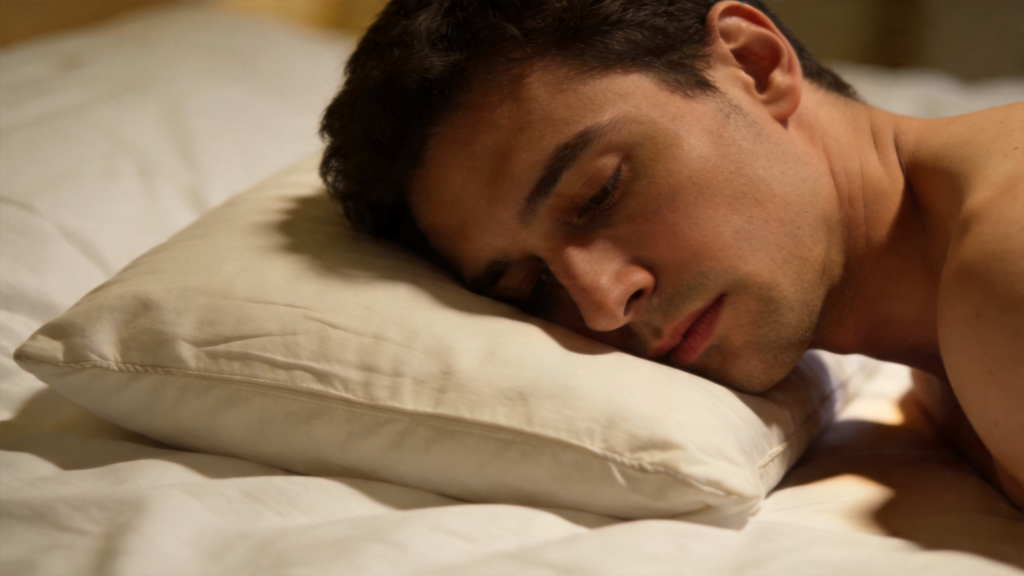
the right height depends almost entirely on sleep position — and most people don’t actually know which position they spend most of the night in, because we move around and we’re asleep when it happens.
side sleepers generally need a higher, firmer pillow to fill the gap between their shoulder and their ear. back sleepers need something lower, with support in the curve under the neck rather than under the head. stomach sleepers — we’re getting to this — ideally need almost no pillow at all under their head, which is its own nightmare to actually pull off.
if your pillow is more than two years old and you have neck problems sleeping, that’s probably the conversation you need to have with yourself before anything else.
the stomach sleeping thing. okay this one actually explains a lot.
I slept on my stomach for most of my twenties. still end up there sometimes when I’m stressed, I think? I wake up that way and have no memory of rolling over.
stomach sleeping is genuinely bad for your neck. like, not in a vague “experts recommend” kind of way. in a mechanically obvious once-you-think-about-it kind of way.
when you sleep face-down, you have to rotate your head to one side. you don’t have a choice. your face needs somewhere to go. so you spend somewhere between five and eight hours with your neck rotated at a significant angle, head turned hard to the left or right, sustained. for hours.
imagine doing that while awake. standing in the middle of your kitchen with your head turned to the right for six hours straight. you’d be horrified. but somehow we do the horizontal version every night and then wonder why we have neck problems sleeping.
the muscles that run along the sides of your neck, the joints in your cervical spine, the little discs in between — none of them are designed for that. they’re designed for movement, for variation, not for being cranked in one direction all night and then expected to be fine in the morning.
I’m not going to tell you to just stop sleeping on your stomach because that’s not how sleep positions work — they’re not a decision you make, they’re a thing that happens to you. but if you know you’re a stomach sleeper and you have chronic neck pain, that’s probably not a coincidence.
what actually helped me: a body pillow along my side. something to hug that makes the side position feel like something my body wants to stay in rather than migrate away from. took a few weeks to actually work. now I wake up on my side most mornings.
if moving positions feels like it’s disrupting your sleep more broadly — making you toss and turn, waking up more often — it might be worth reading about restless sleep causes and remedies, because positional changes and environmental issues often compound each other.
your neck doesn’t know that work is over.
here’s something I did not put together for an embarrassingly long time.
I work at a computer. most of the day. head slightly forward of where it should be, shoulders creeping toward my ears, the classic look-slightly-down-at-a-screen posture that everyone who has ever held a desk job has had.
that position — called forward head posture, which is maybe the least sexy name for something that causes this much suffering — doesn’t end when you stand up and walk to your bedroom. the muscles that have been holding your head in that slightly-craned-forward position all day are still contracted. still doing the thing. your body doesn’t notice that you’ve lain down. it’s still, in some quiet muscular sense, at work.
so you go to bed with a neck that is already tight and already in the wrong position, and then you add six hours of whatever your pillow is doing to it, and then you’re surprised about neck problems sleeping.
this is the same reason falling asleep takes so long for a lot of people — your nervous system never got the signal that the day ended. your neck muscles are one physical version of exactly the same problem. the body needs a runway. a real one.
the fix I actually stuck with: a few minutes of neck stretches before bed. slow, deliberate. ear toward shoulder, hold, switch. chin to chest. slow half-circles. nothing dramatic. just enough to remind the muscles that they’re allowed to stop now. that the screen time is over. that they can let go.

it’s one of those things that sounds completely insufficient until you actually try it consistently for a week. then it’s one of those things you don’t skip.
the cortisol piece — yes, this connects to neck pain too.
this one surprised me.
cortisol — your stress hormone — is supposed to be low at night and rise naturally toward morning to ease you into waking up. when it’s dysregulated, when it spikes too early or stays elevated through the night, it does two things relevant here. one: it contributes to muscle tension that doesn’t release during sleep. two: it pulls you into lighter sleep stages where you’re more likely to end up in a bad position for longer without naturally shifting.
the result can be neck pain that’s partly about your pillow and partly about a body that never fully relaxed. if you’re also waking up around 3 or 4am and feeling strangely alert, that’s often the cortisol pattern — and there’s a lot more on that in the cortisol and 3am waking piece. worth reading if that sounds familiar.
the practical connection: if your neck pain is worst on high-stress weeks, or if you notice your shoulders are basically up near your ears when you finally pay attention to them — stress physiology is probably contributing to the neck problems sleeping pattern, not just your pillow setup.
the mattress thing that nobody wants to hear.
your mattress is doing something to your spine all night too. it’s just easier to blame the pillow because pillows are cheaper and less of a commitment to replace.
if your mattress has soft spots, sags, obvious dips where you sleep — your whole body’s alignment shifts during the night. your hips sink lower than they should. your spine compensates. that compensation travels upward. by the time the effect reaches your neck, you’re already setting yourself up for a rough morning and you don’t even know it.
the thing to look for: if you’re waking up not just with neck pain but with general achiness — back, hips, shoulders, the whole situation — and it mostly clears up once you’ve been awake and moving for an hour or so, that’s a mattress problem more than a pillow problem. the pillow might still need replacing, but the mattress is probably the main event.
room temperature is worth checking too. your body needs its core temperature to drop slightly to maintain deeper sleep — and if the room is too warm, you stay in lighter sleep stages longer, shift positions more, and wake up having spent more time in weird angles. the research tends to suggest around 65 to 68°F as the optimal sleep temperature — cooler than most people keep their rooms.
most mattresses are done after seven to ten years. I know. I know.
when neck problems sleeping are actually something else.
almost all sleep-related neck pain is mechanical. meaning it’s the position, the pillow, the tension, the mattress — something physical that can be adjusted. not a disease, not anything scary, just your body responding to how you’ve been treating it.
but not always.
if the neck pain radiates down your arm — like, there’s numbness or tingling in your hand or fingers when you wake up — that’s worth mentioning to a doctor. that can be a nerve issue, disc issue, something that doesn’t respond to pillow adjustments.
if the pain wakes you up during the night rather than just being there in the morning, mention it. same if you’re also noticing you wake up with a dry mouth, or your partner has mentioned the snoring — those can point toward sleep apnea, which affects sleep quality in ways that compound everything else. the connection between sleep apnea and night symptoms is worth understanding if you haven’t already.
if it’s been going on for more than a couple of weeks and nothing you’ve tried has made any difference, mention it to a doctor.
don’t spend six months quietly suffering because it doesn’t feel “serious enough” to bring up. neck pain connected to nerves, or to cervical spine issues, has actual treatments. catching it earlier is just better.
things that actually moved the needle for me, fast version —
replace the pillow first. if it’s old and flat and you have neck problems sleeping, this is the thing. side sleeper needs more height and firmness than you think. back sleeper needs support under the curve of the neck, not just under the head. stomach sleeper: try a thin pillow or none, and also try to stop sleeping on your stomach.
neck stretches before bed. five minutes. non-negotiable once you see what they do. your neck has been working all day and it needs to be told that the day is over. if you already have a wind-down routine, add this to the end of it — right before you get into bed.
stop looking down at your phone in bed. this sounds stupid but you’re going to bed with neck tension built up from however many hours of screen time, and then you’re lying there adding more. prop it up. hold it higher. or just — stop. The NHS sleep advice on reducing screen stimulation before bed is worth the two minutes it takes to read.
check where your pillow actually sits while you’re sleeping. I had mine in the right position when I got into bed and then by 3am I’d pushed it to some completely different angle and had no idea. trying a pillow with a specific shape — cervical pillow, memory foam with a contoured neck roll — can help it stay where it’s supposed to be.
if the neck pain is coming with morning headaches, that’s a sign your alignment issues are probably more significant and worth addressing more systematically rather than just adjusting the pillow.
morning is the check-in. notice what position you’re in when you wake up. notice where the pillow is. notice which direction the pain is coming from. your body is basically leaving you a note about what happened. it takes about a week of paying attention before you start seeing the pattern.
waking up with neck pain every morning is one of those things that feels inevitable until it doesn’t. it’s easy to assume it’s just aging or stress or something you have to live with, because it’s not dramatic enough to feel like a real problem. just a dull persistent thing.
it’s almost never inevitable.
it’s usually a pillow that stopped doing its job six months ago and you didn’t notice, or a sleep position that’s quietly wrecking you, or muscles that never got a chance to stop working because you went from laptop to bed without any kind of gap. the same patterns that cause restless sleep and the same ones that make it hard to fall asleep in the first place — none of it is random, and none of it is permanent.
all of that is fixable.
start with the pillow. do the stretches. notice the pattern.
most mornings now I can turn my head to the right just fine.
it’s a small thing. it’s not a small thing.
This article is for informational purposes only and does not constitute medical advice. Always consult a qualified healthcare professional for medical concerns.
This article is for informational purposes only and does not constitute medical advice. Always consult a qualified healthcare professional before making changes to your health routine.