

i’ve been looking for a simple sleep debt calculator for years — some tool that would just tell me how behind i actually was. my doctor asked me how many hours i was sleeping and i said “five, maybe six, seven if i’m lucky” and she just kind of paused. wrote something down. didn’t say anything immediately. that pause bothered me more than whatever she wrote.
i’d been doing that for two years. genuinely thought i was fine. a little tired sometimes, sure — but who isn’t, right? turns out the thing that happens with chronic sleep debt is your brain adapts to the deficit so completely that you stop registering how impaired you actually are. the tiredness signal just… quiets. you think you’ve adjusted. what you’ve actually done is lose your reference point for what normal feels like.
that part is what gets me. not that i was tired — that i didn’t know i was tired.
okay so what actually is sleep debt
it’s simpler than it sounds. your body has a sleep need — some number of hours per night where it actually recovers and functions properly the next day. most adults are somewhere in the 7-9 hour range, though exactly where in that range varies by person. sleep debt is just the gap between what you need and what you got.
need 8 hours, sleep 6 — that’s 2 hours of debt that night. do that monday through friday and you’ve accumulated 10 hours going into the weekend. which explains, at least partially, why friday afternoons feel like trying to think through wet cement even when nothing particularly stressful happened that week.
the part that makes this genuinely hard to manage: the debt compounds quietly. one bad week might feel rough but recoverable. three months of that same pattern and you’re operating at a cognitive and emotional baseline that you’ve normalized without realizing it shifted. studies on chronic sleep restriction show that people rate their own sleepiness as barely elevated after weeks of getting 6 hours — while objective performance tests show them declining significantly, day over day. they feel okay. they are not okay. those two things can both be true at once and that’s the problem.
how to actually calculate yours
no app required. the math is just subtraction — you need two numbers.
first: how much sleep does your body actually need? the honest way to figure this out is to track how long you sleep when you have no alarm, no obligations, and a few days to let things settle. not the first day — the first day you might sleep 10 hours from accumulated debt. after 3-4 days of consistent free sleep, the number you naturally land on is roughly your actual need. most people are surprised to find it’s closer to 8 or 8.5 than they’d assumed.
second: how much are you actually getting? not “time in bed” — actual sleep. if you’re in bed from 10:30pm to 6:30am but scrolling until midnight, your sleep window is 6.5 hours, not 8.
subtract the second from the first, multiply by seven for a weekly picture. say your need is 8 hours and your actual average is 6.5 — that’s 1.5 hours of debt per night, 10.5 hours per week. that’s the number you’re working with. it’s not a fun number to look at but it’s a useful one.
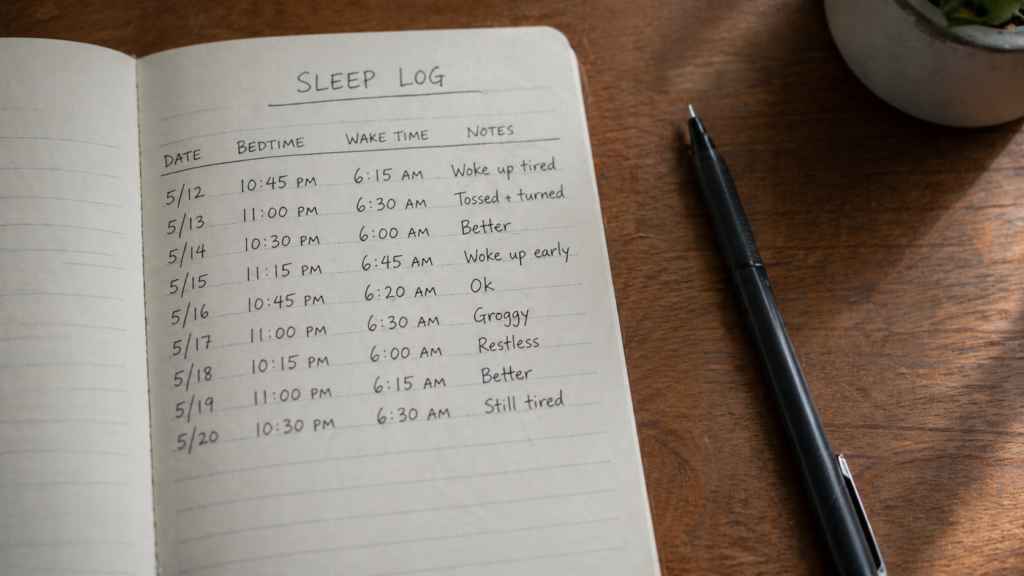
most researchers focus on the trailing two weeks rather than trying to calculate some lifetime total. this is essentially your personal sleep debt calculator — no app needed, just two numbers and basic subtraction. the actionable question is just: what’s your current deficit, and is it getting better or worse?
signs you’re carrying more than you think
because the subjective tiredness signal gets suppressed, it helps to know the other things to look for. some of these are obvious, some less so.
needing caffeine just to reach baseline — not to feel good, but to feel functional — is one of the clearest markers. if you can’t get through a morning without it, something external is propping up what should be your resting state.
emotional reactivity is another one that often gets misattributed. sleep debt dials up the amygdala and dials down the prefrontal cortex’s ability to regulate it, which means small frustrations land harder than they should. you snap at someone over something minor and think “why did i do that” — and the answer might genuinely just be that you’re sleep deprived, not that you have some deeper problem with patience.
falling asleep the moment stimulation drops is a pretty reliable tell. the five-minute doze during a meeting, the book that puts you out in three pages, the car passenger seat that claims you every time. your body is taking every low-stimulation gap it can find to try to chip away at the debt.
and sleeping dramatically long on days off without an alarm — 10, 11 hours — that’s your body trying to tell you something about how far behind it actually is.
can you pay it back
yes, partially. the nuance here matters though.
short-term debt from a rough week or two — yes, you can mostly recover with a few nights of adequate sleep. the cognitive fog clears, the emotional reactivity settles down, things return to normal fairly quickly once you start giving your body what it needs.
chronic debt from months or years of restriction is slower and less complete. one study found it takes up to four days to recover from just one hour of lost sleep. another found that after extended restriction, certain performance markers don’t fully normalize even after three nights of recovery sleep. the body compensates a lot — but not everything, and not as fast as we’d like to believe.
the weekend catch-up strategy specifically is more complicated than it seems helpful. sleeping until noon on sunday when your body’s been waking at 7am all week shifts your cortisol and melatonin timing in a way that makes it harder to fall asleep sunday night — which means you start monday already behind. it’s a bit like borrowing money to pay off debt. resetting a disrupted sleep schedule after weekend oversleeping is its own separate project.
the approach that actually works is gradual extension. add 30 minutes to your sleep window. keep the wake time consistent — the wake time anchors everything. let the bedtime creep earlier slowly. less dramatic than a 12-hour sleep marathon on saturday, but it recovers the debt without destabilizing the schedule that makes good sleep possible in the first place.
what quietly makes it worse
a few things accelerate debt accumulation in ways people don’t always connect to sleep.
alcohol. it helps you fall asleep — genuinely — but suppresses rem sleep and fragments the back half of the night. eight hours after a couple of drinks is not the same as eight hours without. you can hit your time target and still wake up functionally sleep-deprived because the sleep architecture was wrong. this is part of why protecting rem sleep specifically matters — total hours isn’t the whole picture.
stress. chronically elevated cortisol makes sleep less restorative at the same duration. a stressed 8-hour night recovers less than a calm one. which means during high-pressure periods your sleep need effectively goes up just as your ability to get quality sleep goes down. ashwagandha has reasonable evidence for reducing cortisol in people under sustained stress — relevant here not as a sleep drug but as something that addresses the upstream problem.
screens compressing the actual sleep window. getting into bed at 10:30 and scrolling until midnight means your sleep window is 6 hours, not 8, regardless of what time you lay down. the research on screen time and sleep onset is consistent on this one.
and magnesium deficiency, which is underappreciated. low magnesium can reduce sleep efficiency — meaning you’re sleeping but not recovering as fully as you should. magnesium glycinate before bed is one of the lower-risk ways to improve sleep quality without changing your schedule. it’s not going to fix structural debt but it can help the sleep you do get work harder.
the practical side of digging out
there isn’t a shortcut. the only way to pay back sleep debt is to sleep more, over time. but a few things make that more achievable than it sounds.
anchor the wake time first. pick a realistic time and hold it every day including weekends. this is the foundation — the wake time sets your circadian clock, which regulates melatonin and cortisol timing, which determines how well you sleep the next night. once the wake time is stable, gradually move the bedtime earlier in small increments rather than trying to shift an hour all at once.
track it for two weeks. literally just a note in your phone: bedtime, wake time, how you felt on a 1-5 scale. the pattern that emerges is more motivating than anything you’ll read about why sleep matters. seeing “i was a 2 on days i slept 6 hours and a 4 on days i slept 8” makes the habit feel less abstract.
and if you fix the schedule and you’re still waking up exhausted after 8 hours — look at quality, not just quantity. sleep apnea is one of the most common and most underdiagnosed reasons someone can sleep an adequate number of hours and still carry functional debt. worth ruling out before assuming the problem is purely behavioral.
for a deeper look at the research behind sleep debt and recovery, the Sleep Foundation’s overview of sleep debt is a solid starting point before talking to a doctor.

the number that actually matters
a lot of people get into tracking sleep debt as a precision exercise — trying to calculate the exact number, obsessing over whether they’ve zeroed it out, treating it like a financial account that needs to balance to the minute. that granularity isn’t really supported by the science and it has a way of turning sleep into a source of anxiety rather than something your body does on its own.
the number that matters is just the trend. are you sleeping more nights at your full needed amount than you were last month? is the caffeine dependency loosening slightly? are the afternoons less brutal? those directional signals tell you more than any precise debt figure.
two years running on five or six hours, i had genuinely forgotten what actually rested felt like. not a little better — actually different. clearer. more even. less like everything requires slightly more effort than it should.
that’s the thing you’re working toward. not a number on a tracker. just that.
i’ve been looking for a simple sleep debt calculator for years — some tool that would just tell me how behind i actually was. my doctor asked me how many hours i was sleeping and i said “five, maybe six, seven if i’m lucky” and she just kind of paused. wrote something down. didn’t say anything immediately. that pause bothered me more than whatever she wrote.
i’d been doing that for two years. genuinely thought i was fine. a little tired sometimes, sure — but who isn’t, right? turns out the thing that happens with chronic sleep debt is your brain adapts to the deficit so completely that you stop registering how impaired you actually are. the tiredness signal just… quiets. you think you’ve adjusted. what you’ve actually done is lose your reference point for what normal feels like.
that part is what gets me. not that i was tired — that i didn’t know i was tired.
okay so what actually is sleep debt
it’s simpler than it sounds. your body has a sleep need — some number of hours per night where it actually recovers and functions properly the next day. most adults are somewhere in the 7-9 hour range, though exactly where in that range varies by person. sleep debt is just the gap between what you need and what you got.
need 8 hours, sleep 6 — that’s 2 hours of debt that night. do that monday through friday and you’ve accumulated 10 hours going into the weekend. which explains, at least partially, why friday afternoons feel like trying to think through wet cement even when nothing particularly stressful happened that week.
the part that makes this genuinely hard to manage: the debt compounds quietly. one bad week might feel rough but recoverable. three months of that same pattern and you’re operating at a cognitive and emotional baseline that you’ve normalized without realizing it shifted. studies on chronic sleep restriction show that people rate their own sleepiness as barely elevated after weeks of getting 6 hours — while objective performance tests show them declining significantly, day over day. they feel okay. they are not okay. those two things can both be true at once and that’s the problem.
how to actually calculate yours
no app required. the math is just subtraction — you need two numbers.
first: how much sleep does your body actually need? the honest way to figure this out is to track how long you sleep when you have no alarm, no obligations, and a few days to let things settle. not the first day — the first day you might sleep 10 hours from accumulated debt. after 3-4 days of consistent free sleep, the number you naturally land on is roughly your actual need. most people are surprised to find it’s closer to 8 or 8.5 than they’d assumed.
second: how much are you actually getting? not “time in bed” — actual sleep. if you’re in bed from 10:30pm to 6:30am but scrolling until midnight, your sleep window is 6.5 hours, not 8.
subtract the second from the first, multiply by seven for a weekly picture. say your need is 8 hours and your actual average is 6.5 — that’s 1.5 hours of debt per night, 10.5 hours per week. that’s the number you’re working with. it’s not a fun number to look at but it’s a useful one.
most researchers focus on the trailing two weeks rather than trying to calculate some lifetime total. this is essentially your personal sleep debt calculator — no app needed, just two numbers and basic subtraction. the actionable question is just: what’s your current deficit, and is it getting better or worse?
signs you’re carrying more than you think
because the subjective tiredness signal gets suppressed, it helps to know the other things to look for. some of these are obvious, some less so.
needing caffeine just to reach baseline — not to feel good, but to feel functional — is one of the clearest markers. if you can’t get through a morning without it, something external is propping up what should be your resting state.
emotional reactivity is another one that often gets misattributed. sleep debt dials up the amygdala and dials down the prefrontal cortex’s ability to regulate it, which means small frustrations land harder than they should. you snap at someone over something minor and think “why did i do that” — and the answer might genuinely just be that you’re sleep deprived, not that you have some deeper problem with patience.
falling asleep the moment stimulation drops is a pretty reliable tell. the five-minute doze during a meeting, the book that puts you out in three pages, the car passenger seat that claims you every time. your body is taking every low-stimulation gap it can find to try to chip away at the debt.
and sleeping dramatically long on days off without an alarm — 10, 11 hours — that’s your body trying to tell you something about how far behind it actually is.
can you pay it back
yes, partially. the nuance here matters though.
short-term debt from a rough week or two — yes, you can mostly recover with a few nights of adequate sleep. the cognitive fog clears, the emotional reactivity settles down, things return to normal fairly quickly once you start giving your body what it needs.
chronic debt from months or years of restriction is slower and less complete. one study found it takes up to four days to recover from just one hour of lost sleep. another found that after extended restriction, certain performance markers don’t fully normalize even after three nights of recovery sleep. the body compensates a lot — but not everything, and not as fast as we’d like to believe.
the weekend catch-up strategy specifically is more complicated than it seems helpful. sleeping until noon on sunday when your body’s been waking at 7am all week shifts your cortisol and melatonin timing in a way that makes it harder to fall asleep sunday night — which means you start monday already behind. it’s a bit like borrowing money to pay off debt. resetting a disrupted sleep schedule after weekend oversleeping is its own separate project.
the approach that actually works is gradual extension. add 30 minutes to your sleep window. keep the wake time consistent — the wake time anchors everything. let the bedtime creep earlier slowly. less dramatic than a 12-hour sleep marathon on saturday, but it recovers the debt without destabilizing the schedule that makes good sleep possible in the first place.
what quietly makes it worse
a few things accelerate debt accumulation in ways people don’t always connect to sleep.
alcohol. it helps you fall asleep — genuinely — but suppresses rem sleep and fragments the back half of the night. eight hours after a couple of drinks is not the same as eight hours without. you can hit your time target and still wake up functionally sleep-deprived because the sleep architecture was wrong. this is part of why protecting rem sleep specifically matters — total hours isn’t the whole picture.
stress. chronically elevated cortisol makes sleep less restorative at the same duration. a stressed 8-hour night recovers less than a calm one. which means during high-pressure periods your sleep need effectively goes up just as your ability to get quality sleep goes down. ashwagandha has reasonable evidence for reducing cortisol in people under sustained stress — relevant here not as a sleep drug but as something that addresses the upstream problem.
screens compressing the actual sleep window. getting into bed at 10:30 and scrolling until midnight means your sleep window is 6 hours, not 8, regardless of what time you lay down. the research on screen time and sleep onset is consistent on this one.
and magnesium deficiency, which is underappreciated. low magnesium can reduce sleep efficiency — meaning you’re sleeping but not recovering as fully as you should. magnesium glycinate before bed is one of the lower-risk ways to improve sleep quality without changing your schedule. it’s not going to fix structural debt but it can help the sleep you do get work harder.
the practical side of digging out
there isn’t a shortcut. the only way to pay back sleep debt is to sleep more, over time. but a few things make that more achievable than it sounds.
anchor the wake time first. pick a realistic time and hold it every day including weekends. this is the foundation — the wake time sets your circadian clock, which regulates melatonin and cortisol timing, which determines how well you sleep the next night. once the wake time is stable, gradually move the bedtime earlier in small increments rather than trying to shift an hour all at once.
track it for two weeks. literally just a note in your phone: bedtime, wake time, how you felt on a 1-5 scale. the pattern that emerges is more motivating than anything you’ll read about why sleep matters. seeing “i was a 2 on days i slept 6 hours and a 4 on days i slept 8” makes the habit feel less abstract.
and if you fix the schedule and you’re still waking up exhausted after 8 hours — look at quality, not just quantity. sleep apnea is one of the most common and most underdiagnosed reasons someone can sleep an adequate number of hours and still carry functional debt. worth ruling out before assuming the problem is purely behavioral.
for a deeper look at the research behind sleep debt and recovery, the Sleep Foundation’s overview of sleep debt is a solid starting point before talking to a doctor.
the number that actually matters
a lot of people get into tracking sleep debt as a precision exercise — trying to calculate the exact number, obsessing over whether they’ve zeroed it out, treating it like a financial account that needs to balance to the minute. that granularity isn’t really supported by the science and it has a way of turning sleep into a source of anxiety rather than something your body does on its own.
the number that matters is just the trend. are you sleeping more nights at your full needed amount than you were last month? is the caffeine dependency loosening slightly? are the afternoons less brutal? those directional signals tell you more than any precise debt figure.
two years running on five or six hours, i had genuinely forgotten what actually rested felt like. not a little better — actually different. clearer. more even. less like everything requires slightly more effort than it should.
that’s the thing you’re working toward. not a number on a tracker. just that.
This article is for informational purposes only and does not constitute medical advice. Always consult a qualified healthcare professional before making changes to your health routine.