My sleep tracker was making me more anxious than the actual bad sleep.
Every morning, same routine: open the app, stare at the “sleep stages” graph, go ugh. I’d already tried the obvious stuff — cutting caffeine after noon, magnesium glycinate, adjusting my bedtime in both directions, blackout curtains. Some of it helped a little. None of it really stuck, you know?
So when Linda from my running group — she’s 54, annoyingly well-rested, the kind of person who wakes up before her alarm and is actually happy about it — mentioned she’d been using tart cherry juice for sleep every night, I didn’t roll my eyes. I was past that. I said tell me more.
I picked up a bottle of concentrate that weekend and committed to two weeks. Not one or two nights — two actual weeks.
Here’s what happened. And what didn’t.
Why Would Tart Cherry Juice Help You Sleep at All?
This was my first question too, because “drink cherry juice for sleep” sounds like something a wellness influencer says alongside “just set an intention.” So I actually looked into the mechanism before I started, and it’s more interesting than I expected.
Tart cherries — the Montmorency variety, not the sweet kind — have naturally occurring melatonin in them. Not a lot, honestly. We’re talking 0.01 to 0.13 micrograms per gram of fruit. A regular melatonin gummy from any drugstore has something like 1,000 to 10,000 times that amount. So the argument for tart cherry juice for sleep isn’t that it dumps a big melatonin dose into you. It’s kind of the opposite: that tiny, food-based amount may work more like a gentle nudge to your system, supporting your body’s own melatonin rhythm rather than overriding it. Whether that’s actually better than taking a supplement — I genuinely don’t know. But it’s at least a coherent argument.
Then there’s tryptophan — same amino acid as in turkey, yes. Your body converts it to serotonin first and then to melatonin, so the cherries are kind of giving your brain raw ingredients to make its own sleep signal. I’ve seen a similar logic used to explain why glycine for sleep has gotten so much attention recently. These upstream amino acid approaches seem to work differently than just handing your body a finished hormone.
The third piece — and honestly this one surprised me the most — is anthocyanins. The dark red pigment compounds. Strong anti-inflammatories, same family as what’s in blueberries. And there’s actually solid research linking chronic low-grade inflammation to worse sleep quality: more nighttime wake-ups, less time in deep sleep stages, harder recovery. I’d never really connected inflammation with sleep before, but it makes a weird kind of sense. Your body’s a little on edge when it’s inflamed. That’s not a state that lends itself to deep, solid sleep.
What Studies on Tart Cherry Juice and Sleep Actually Found
Okay, so here’s where I want to be upfront about something: the research base here is real but it’s small. We’re not talking about huge long-term trials. Most of the tart cherry juice and sleep studies are short, 7 to 14 days, and involve relatively few people. Keep that context in mind.
That said, the most widely cited study — published in the European Journal of Nutrition — ran 20 people through a week of twice-daily Montmorency tart cherry concentrate. The results compared to placebo: about 25 extra minutes of sleep per night, higher melatonin levels measured in urine, and better self-reported sleep quality. Twenty-five minutes sounds small. But over a week that’s almost three extra hours of sleep. In real daily-life terms, that’s the difference between feeling okay and feeling pretty wrecked.
There’s also a trial specifically on older adults with insomnia, which I paid more attention to than the general studies because that’s actually a hard group to help. Melatonin production drops significantly as you age, and most interventions that help younger people do almost nothing for older adults. Two weeks of daily tart cherry juice reduced the time participants spent lying awake after initially falling asleep. Not dramatically, but consistently, and that matters.
The other place this data shows up is athletic recovery research. Tart cherry has been used by athletes for years to reduce post-workout muscle soreness — that’s well established. And in those same studies, athletes kept reporting sleeping better as a side effect. Which makes total sense once you think about it: physical discomfort at night is a major, underappreciated reason why so many people take forever to fall asleep. Quiet the inflammation, and you sleep more comfortably even without targeting sleep directly.
What this research does not say: that tart cherry juice works fast, or that it fixes serious insomnia, or that it works for everyone. I want to be clear about that.
The Sleep Problem It Seems to Target Most
Here’s the thing that I think gets lost in most articles about tart cherry juice for sleep: the studies show the biggest improvement in nighttime waking, not in how long it takes to fall asleep. And those are genuinely different problems.
If your issue is that you lie in bed for 45 minutes unable to turn your brain off before sleep — racing thoughts, replaying conversations, planning tomorrow — tart cherry probably isn’t your main answer. But if you fall asleep fine and then keep waking up? That’s what this seems to actually help. The 3am wake-up, the 2:30am wake-up, lying there for an hour before drifting off again. That specific pattern.
My own problem was exactly that. I’d fall asleep no problem, be out by 10:30, and then suddenly wide awake at 3am or so. Some nights I’d fall back asleep in 20 minutes. Other nights I’d be half-awake until my alarm, which is just — not a good way to spend three hours of your life. If you’ve ever gone deep on why waking up at 3am every night happens, you know there are actually multiple potential causes: cortisol cycling up, blood sugar dropping off, even the liver doing its overnight work in those early morning hours. Tart cherry doesn’t fix all of those. But if declining melatonin is part of your picture — which for a lot of adults, especially over 45, it genuinely is — it may help you stay asleep longer.
How to Actually Use Tart Cherry Juice for Sleep (What I Got Wrong at First)
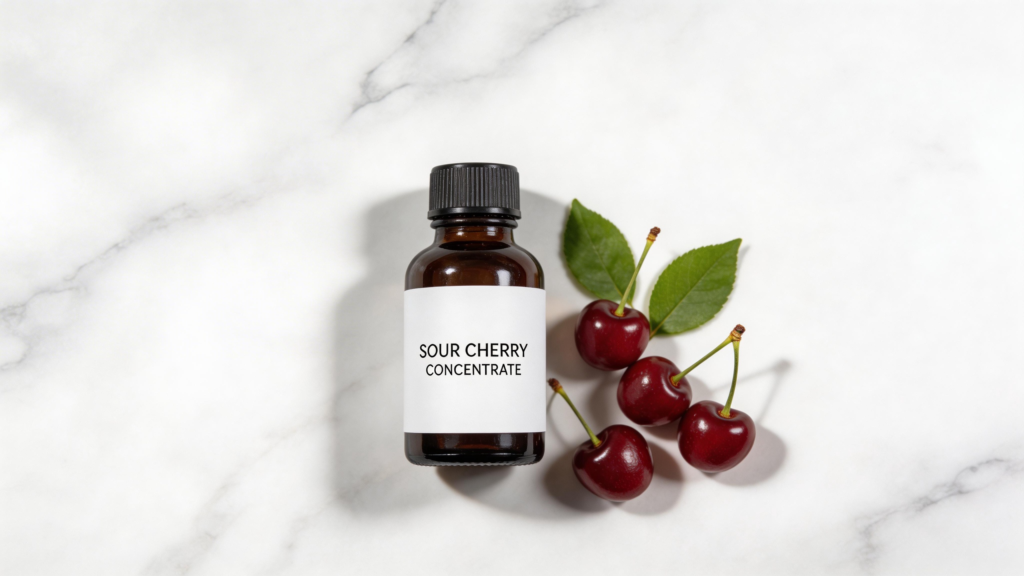
Two forms: regular bottled juice or concentrate. I started with the juice and switched to concentrate pretty fast. The concentrate is more potent, way easier to store, and a bottle runs $25 to $30 and lasts me close to five or six weeks at the dose I use. The thing you’re looking for is 100% Montmorency tart cherry concentrate, no added sugar. This matters because there’s a lot of stuff on shelves that says “cherry” on the label in big letters and then buried in the ingredients it’s apple juice with cherry flavor. Not the same thing at all. Check the ingredients, not just the label.
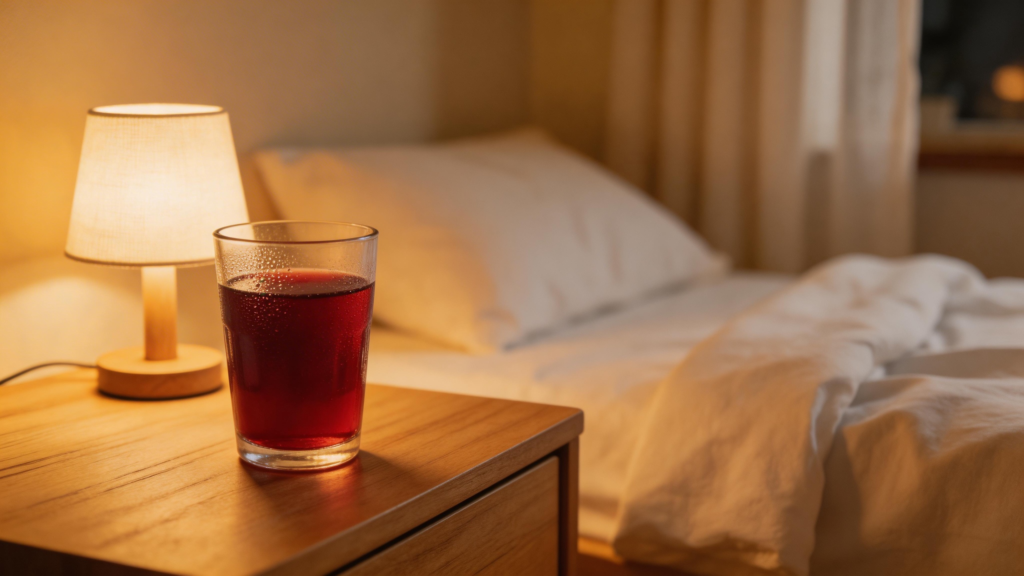
Dosing: the sleep studies use about 8 ounces of regular juice or 1 to 2 tablespoons of concentrate in water, twice daily — morning and roughly 90 minutes before bed. I’ll be honest, the morning dose is the one I keep forgetting. Most days I just do the evening one, and I still notice a difference. So if you’re starting out and want to keep it simple, the evening dose is where to begin.
Taste: it’s pretty sour and kind of earthy. My 12-year-old tried it once, made a face like I’d given her motor oil, and has refused to be near the bottle since. I’ve gotten used to it, it’s not bad cold, and if you really can’t do the sourness straight you can mix it in sparkling water with a bit of lemon. That’s actually pretty good.
The thing I got completely wrong: I gave it three days, felt nothing, and texted Linda saying it wasn’t working. She told me to wait. I waited. Around day 9 or 10, I noticed I wasn’t lying awake at 3am as often. By day 12, I was sleeping noticeably more solidly through the night. So commit to the two weeks before you decide anything. Keep a quick log — just a number from 1 to 10 in your phone every morning, takes five seconds — so you have real data to compare and you’re not just relying on a vague sense of whether things improved.
Also: tart cherry juice is not a fix for a chaotic sleep schedule. If you’re going to bed at different times every night, scrolling your phone until you pass out, relying on weekend catch-up sleep — none of that is something cherry juice compensates for. Getting your sleep schedule onto a consistent rhythm is the foundation. This is something you add on top of that, not instead of it.
Who Seems to Get the Most Out of This
Based on the research and from reading a lot about this — not just the studies but forums, sleep communities, that kind of thing — a few patterns show up.
People over 45 consistently seem to be the best fit. Melatonin production really does drop in your mid-forties and beyond, and a gentle food-based approach to nudging it back up makes a lot of physiological sense. The older-adult insomnia study showed the most consistent results of anything I found on tart cherry juice for sleep.
People whose main issue is staying asleep, not falling asleep. That’s the specific thing the research points to, and it matched my experience.
People who’ve had bad experiences with melatonin supplements. The groggy next-morning feeling, the overly vivid dreams — those are usually from doses that are way too high relative to what your body actually needs. The micro-amount in tart cherry juice almost never causes that. It’s a meaningfully different experience.
And honestly — people who want something that feels like a ritual rather than a pill schedule. There’s something about intentionally mixing a small drink, sitting with it for a few minutes before bed, not having it be another capsule you’re swallowing — that has some psychological value too. Hard to measure but I think it’s real.
A Few Things to Know Before You Start
Sugar is in there. Not huge amounts at 1 to 2 tablespoons, but worth knowing, especially if you’re managing blood sugar carefully. Dilute it well.
Drug interactions: the polyphenols in tart cherry can affect how certain medications are metabolized, particularly some blood thinners and blood pressure drugs. If you’re on anything regularly, just ask your pharmacist — quick conversation, worth doing.
And if you’re dealing with real, serious chronic insomnia — months of genuinely disruptive sleep that’s affecting your daily life — please know that tart cherry juice is a supportive addition, not a treatment. Cognitive behavioral therapy for insomnia (CBT-I) has the best evidence for that level of severity. More people should know it exists.
How It Fits With Other Sleep Aids
One thing I appreciate about tart cherry juice for sleep is that it stacks fine with other approaches because the mechanisms don’t overlap.
Chamomile tea before bed works via apigenin and GABA receptors — it’s a nervous system calmer, totally different from melatonin. I do chamomile around 9pm, tart cherry around 10:30. No conflict, they’re doing separate jobs.
Glycine lowers core body temperature, which is a key physical signal for sleep onset. Again, completely different mechanism. These can work together without stepping on each other.
I also take magnesium glycinate with dinner. So yes, that’s three things in my evening. But each takes about ten seconds, none of them interact badly, and the combination has produced better consistent sleep than any one thing alone. I can’t tell you exactly what percentage each one is contributing. Honestly, I don’t think it matters that much — the end result is what counts.

My Actual Bottom Line
Tart cherry juice for sleep didn’t transform my nights. I want to say that clearly, because the last thing this space needs is another overhyped supplement post.
What it did: I wake up less in the middle of the night. When I do wake up, I fall back asleep faster. And on the mornings when I forgot to take it the night before, I feel it — the sleep is a bit more fragmented, a bit less solid. Noticing the absence is, in my experience, a more reliable signal than noticing when you first start taking something, because early on there’s too much hope and expectation getting in the way.
The science backs it up reasonably well, better than most things in the sleep supplement world anyway. The mechanism makes sense. The side effects are basically nothing. And it’s a food, which I find genuinely reassuring — your body knows how to handle a food in a way it doesn’t with a synthetic compound.
If the 3am wake-up thing is your issue, or if you’re over 45 and your sleep has just gotten more fragmented over the years — I think tart cherry juice for sleep is worth an honest two-week trial. Good Montmorency concentrate, evening dose every night, track something simple. Give it the time it needs.
Linda was right. I’m slightly annoyed about that but also sleeping better, so.
This article is for informational purposes only and does not constitute medical advice. Always consult a qualified healthcare professional before making changes to your health routine.