i put off trying passionflower for sleep for an embarrassingly long time. kept seeing it listed in those “natural sleep remedies” roundups — you know the ones, the articles that also recommend lavender diffusers and turning your phone off two hours before bed. and i kind of lumped it in with all the other stuff that sounds nice but doesn’t actually do anything.
then a friend mentioned she’d been using it for a few weeks and her sleep had genuinely changed. not dramatically. but the part where she used to lie there rewinding conversations from the day, replaying things she should have said differently — that part had quieted down. she was falling asleep faster.
that got my attention. because that specific thing — the mental noise at night — is exactly where most supplements fall flat.
so i actually looked into it. and here’s what i found.
what passionflower is
passiflora incarnata. climbing vine. native to the southeastern united states, though it ended up in europe pretty early and got folded into traditional medicine there too.
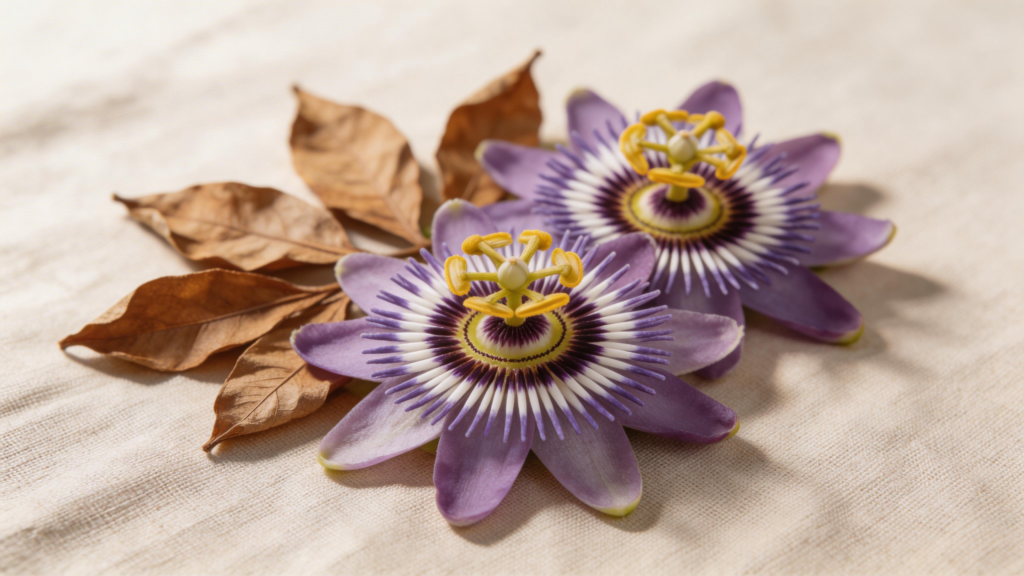
the flowers are genuinely strange-looking — intricate, almost alien — which is probably why it ended up with such a dramatic name. the parts used medicinally are the aerial parts. leaves, stems, flowers, dried.
you’ll find it as a tea most commonly. also capsules, tinctures, liquid extracts. a lot of commercial sleep supplements combine it with valerian root or lemon balm, which makes it harder to figure out what’s actually doing the work when you take one of those blends.
it’s been used for anxiety and sleep for a long time. centuries, actually. that doesn’t automatically make it effective — plenty of traditional remedies fall apart when you look at the mechanism — but it does mean we’d probably know by now if it was dangerous.
how it works in your brain
this is the part i found most interesting.
GABA — gamma-aminobutyric acid, if you want the full name — is basically your brain’s brake pedal. inhibitory neurotransmitter. slows things down. when it’s doing its job, your nervous system quiets and sleep starts to feel possible. when it’s not… things get loud.
a lot of sleep medications work by hitting GABA receptors hard. benzodiazepines, for instance. effective, yes. but also dependency, tolerance, rebound insomnia when you stop. blunt instrument on a sensitive system.
passionflower seems to do something gentler. the main compound is chrysin — a flavonoid that appears to bind to GABA-A receptors. there are others too, vitexin and isovitexin, that probably contribute. the combined effect seems to nudge GABA activity upward, but through a pathway that doesn’t carry the same risks.
the experience people describe isn’t sedation exactly. more like the volume gets turned down. thoughts are still there. just not as insistent. for someone whose main problem is a brain that won’t shut up at 11pm, that’s actually the right kind of help.
what the studies show
i want to be straight with you about this.
the human research exists. it’s real. but it’s limited — small samples, short durations, not much replication. that doesn’t make it useless. it means we hold the conclusions loosely.
one study had participants drink passionflower tea every night for a week and tracked their sleep using diary ratings. sleep quality scores improved compared to placebo. people reported falling asleep more easily, feeling more rested. modest improvements, but consistent ones. view study
another trial compared passionflower extract directly to a low-dose sedative medication. passionflower held up on several measures — and actually outperformed the drug on next-day job performance. less grogginess. that’s a meaningful finding if it ever gets properly replicated.
animal studies are more extensive and pretty consistently supportive. but animal research doesn’t always transfer cleanly, so i’d weight it less heavily than the human trials.
the honest summary: promising, not proven. not placebo noise. but not at the level of something like magnesium glycinate either, which has decades of larger trials behind it. you’re making a reasonable bet. not a certainty.
who it’s most likely to help
passionflower seems most useful for a specific kind of sleep problem.
the kind where you lie down at a reasonable hour, you’re actually tired, nothing is physically wrong — but your brain just won’t stop. replaying conversations. running through tomorrow’s list. racing thoughts at bedtime that you can’t seem to step off. that’s the profile where the GABA mechanism makes the most sense.
it’s probably less useful if the root cause is something else entirely. circadian disruption, chronic pain, sleep apnea, hormonal shifts — passionflower isn’t touching those. the mechanism just isn’t relevant.
one extra thing worth mentioning: some studies show it helps with daytime anxiety too, not just sleep. so if that’s part of your picture, there might be more benefit here than just the nighttime piece.
how to actually take it
the easiest way is tea. dried herb, about a teaspoon, hot water, ten minutes steep. drink it maybe 30 to 45 minutes before bed — not right as you’re climbing in. give it time to actually do something.
there’s also something to be said for the ritual itself. making tea, sitting with it, slowing down before sleep. even separate from what the passionflower is doing pharmacologically, that wind-down routine is worth something.
for capsules or extracts: most studies have used somewhere around 300 to 400mg of dried extract equivalent. look for something standardized to flavonoid content if you can find it. the variability in unregulated supplements is real and it matters.
on the blended supplements — valerian plus passionflower plus lemon balm, that kind of thing. popular. but if you want to know whether passionflower specifically is helping you, start with it alone. otherwise you’ll never be able to sort out what’s doing what.
safety and what to watch for
short-term use at reasonable doses is generally considered safe. side effects are mild when they show up at all — occasional drowsiness, sometimes a bit of dizziness. nothing that registers as a serious concern in the literature. Sleep Foundation
a few things worth flagging though.
if you’re on any CNS depressants — sedatives, anxiolytics, certain antihistamines — check with your doctor before adding passionflower. stacking things that both affect GABA can amplify effects more than you’d expect. that’s not always a problem but it’s worth knowing.
pregnancy: generally advised to avoid. animal studies suggest possible uterine stimulation. not a risk worth taking.
and the standard supplement caveat — if you’re on prescription medications, check interactions. the list isn’t long, but it exists.
how it fits with other sleep supplements
where does passionflower actually sit. that’s the question i kept coming back to.
if you’re weighing up passionflower for sleep against other supplements, it helps to understand what each one is actually doing.
it’s not the same thing as magnesium glycinate — different system entirely. magnesium works more through NMDA receptors and body temperature regulation. passionflower is the GABA pathway. so using both isn’t redundant. though i’d still start with one at a time so you actually know what’s working.
glycine is another one that operates differently — thermoregulation, glycine receptors, not GABA at all. good evidence base. worth knowing about if passionflower doesn’t fully do it for you.
and tart cherry juice is more the melatonin angle — sleep timing rather than sleep initiation anxiety. different problem, different tool.
if the racing thoughts issue is persistent and passionflower alone isn’t enough, it might also be worth looking at whether there’s a broader cognitive or behavioral piece involved. sometimes supplements can only take you so far.
does passionflower for sleep actually work — the honest summary
passionflower for sleep isn’t hype. but it’s not a sure thing either.
the mechanism makes sense. the evidence is modest but real. it’s cheap, it’s low-risk, and the tea version is pleasant enough that even if it doesn’t move the needle much for your sleep, you’re not losing anything meaningful by trying it.
if anxiety or mental noise is what’s keeping you up — specifically that — it’s a reasonable thing to try. give it two consistent weeks. see what happens.
whether it ends up being a regular part of your routine or just another thing that didn’t quite work out… i genuinely can’t predict that. the research only gets you so far. your own two weeks will tell you more than any study.
aaa
This article is for informational purposes only and does not constitute medical advice. Always consult a qualified healthcare professional before making changes to your health routine.