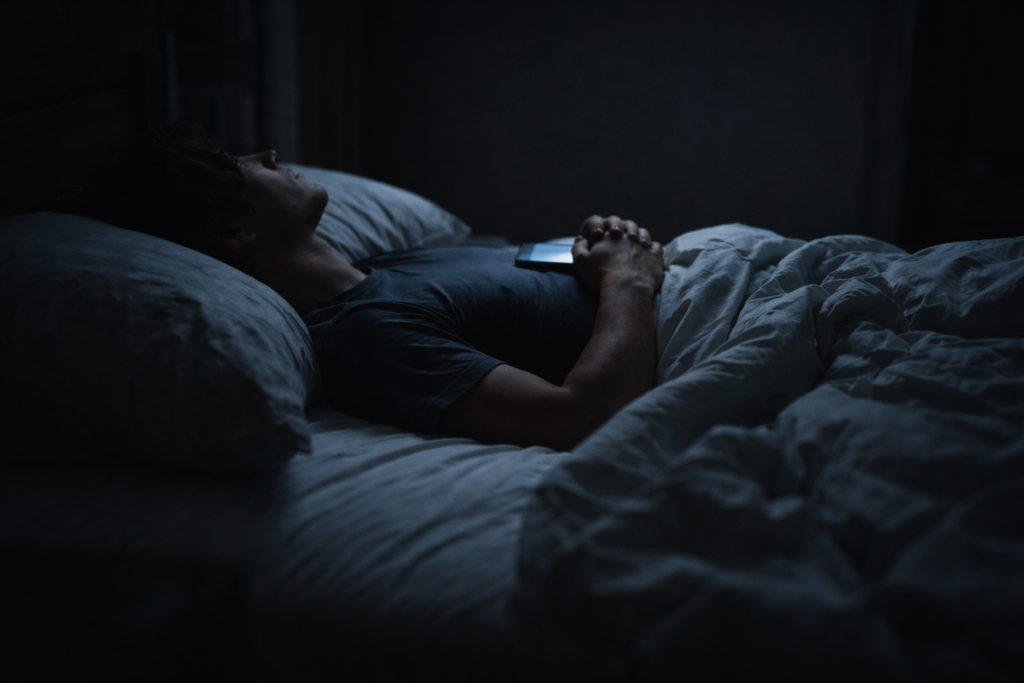
finding the best sleeping position for IT band pain was the last thing I figured out — and probably the thing that changed my mornings the most. the IT band doesn’t hurt while you’re sleeping. that’s the thing. it just. waits.
you finish a run, feel okay, go to bed, wake up at 2am with this very specific burning tightness on the outside of your knee that makes rolling over feel like a minor punishment. or you sleep fine, stand up, take three steps toward the bathroom —
and there it is.
that lateral pull. that outside-of-the-knee thing. the one that tells you today is going to be a negotiation between you and your own leg before you’ve even had coffee.
I did this loop for about four months. run, recover badly, wake up stiff, limp to the kettle, tell myself it’d be fine by the afternoon. sometimes it was. sometimes it wasn’t. what I didn’t figure out until embarrassingly late is that how I was sleeping was actively making things worse — not just failing to help, actually making it worse — and a pretty small positional change shifted my mornings more than anything else I tried.
here’s what’s actually going on, and what to do about it.
why sleep position affects IT band pain at all
the iliotibial band runs along the outside of your thigh. hip down to just below the knee. it’s not a muscle — it’s connective tissue, which means it doesn’t stretch the way a hamstring does. what it does is tighten, compress, and get irritated. and stay irritated, if the structures around it are being held in the wrong position for long enough.
and when you sleep, you hold a position for hours.
hours. largely unmoving. whatever your hips and knees are doing at 11pm is roughly what they’re doing at 3am and 5am and when your alarm goes off. if that position is putting sustained tension or compression on an already-irritated IT band, you’re not recovering overnight. you’re just extending the problem in the dark, unconsciously, for six to eight hours in a row.
the two main culprits are hip adduction — where your top leg drops forward or crosses the midline, pulling the band taut — and direct compression, meaning you’re lying on the affected side and pressing the whole lateral thigh into the mattress for hours at a stretch. both of these are extremely common default sleep positions. which is why IT band syndrome and bad mornings tend to go together so reliably, and why people with IT band issues often feel worse first thing than they did when they went to bed.
the best sleeping position for IT band pain
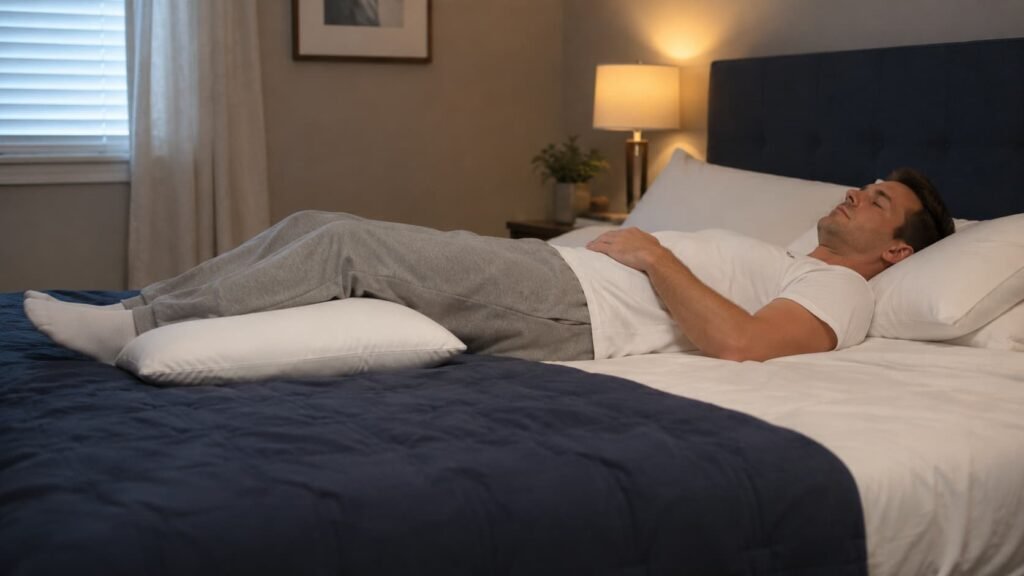
back sleeping with a pillow under your knees. that’s the one. that’s the position that puts the least sustained tension on the IT band and keeps your hip and knee alignment neutral through the night.
not a decorative pillow. a firm one — or a rolled blanket, or a bolster — tucked under both knees. enough to create a slight bend at the knee, maybe twenty to thirty degrees. that small angle takes the tension off the IT band at the knee insertion point and lets the whole lateral leg just. decompress. feet hip-width apart, toes pointing roughly up. nothing twisted, nothing crossed.
if you’re someone who genuinely cannot stay on your back — chronic side sleeper, can’t switch, have tried — put a rolled blanket or a firm pillow on either side of your hips. it creates a physical barrier that your body tends to settle against instead of rolling. more reliable than willpower, which runs out around 2am.
if back sleeping isn’t happening: side sleeping on the good leg
the unaffected side goes down. the leg that doesn’t hurt is the one against the mattress. then — and this is the part that actually matters — a firm pillow between your knees. thick enough to keep your top hip level with your bottom hip.
that’s what the pillow is actually doing: stopping the top leg from dropping forward. that drop is hip adduction. hip adduction is what loads the IT band. the pillow stops the drop, the IT band stays in a neutral position instead of being slowly stretched over hours while you sleep through it completely unaware.
between the knees. not the ankles. between the ankles only aligns the lower leg — it doesn’t stabilize the hip, which is where the actual problem originates. and the pillow needs real loft. something that holds its shape at 3am, not something that compresses flat by midnight and leaves your knees touching anyway.
a body pillow is even better for this. you hug the front while it runs between your legs, the whole hip-knee chain stays aligned, and you don’t have to consciously hold a position while you’re unconscious. which is the point. 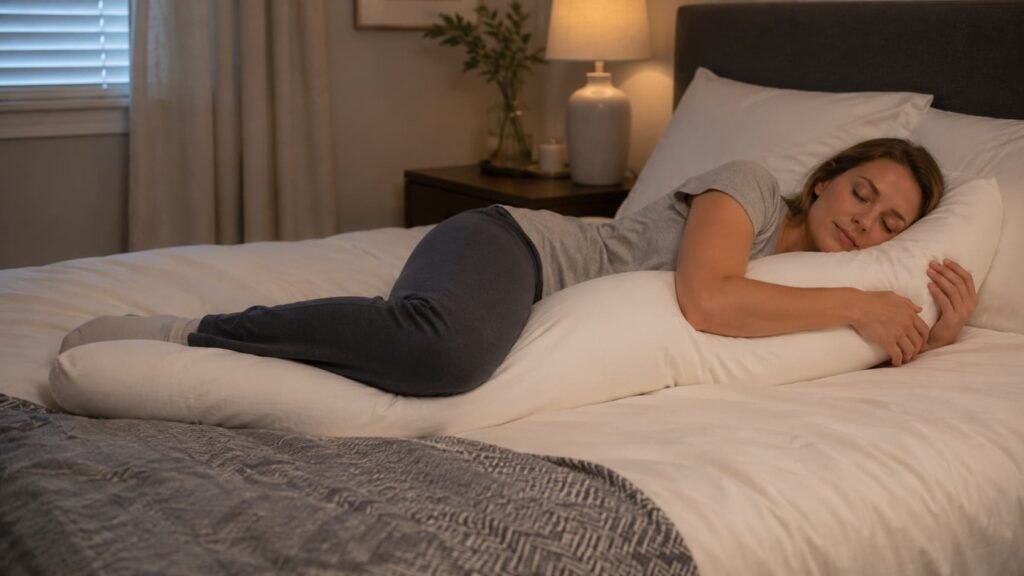
positions to stop sleeping in
on the affected side. direct compression on an irritated IT band for six to eight hours and then wondering why the first three steps of the morning are terrible. you’ll feel it immediately when you stand up — that’s not bad luck, that’s the tissue telling you exactly what happened.
side sleeping without anything between the knees. feels fine. the hip drifts into adduction while you sleep. you don’t notice because you’re asleep. you notice the next morning. this is probably the most common sleep mistake specifically for runners with IT band issues — the position feels neutral and comfortable, and the damage accumulates invisibly over hours.
stomach sleeping. internally rotates the hip and knee. most stomach sleepers also end up with one leg kicked out to the side at some point, which creates exactly the kind of asymmetric lateral loading the IT band doesn’t need sustained for half the night. it’s the least controllable position — you can start on your stomach intentionally and end up completely differently by 3am.
the ten minutes around sleep that matter as much as the position
foam rolling before bed. two to three minutes on the lateral thigh and TFL — that’s the tensor fasciae latae, the muscle at the front of your hip that feeds directly into the IT band. if the TFL is wound up when you go to sleep, it’ll still be wound up when you wake up, and it’ll have been holding that tension for eight hours. slow passes, pause on tight spots, let it release. not aggressive. not painful. just — releasing some of what accumulated during the day before you ask the body to hold a position for hours. 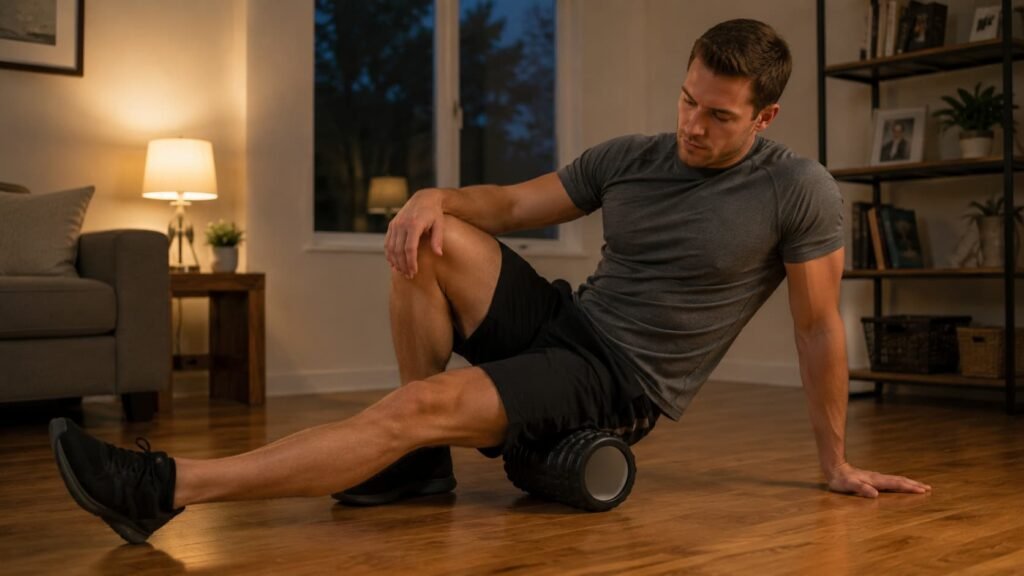
don’t do static IT band stretches right before bed. I did this wrong for a long time. crossing one leg over the other, pulling the leg across — that puts the band under load. for an acutely inflamed IT band, loading it right before trying to let it recover overnight is exactly backwards. foam rolling is the better pre-sleep move. gentle decompression, not tension. we’ve covered this in the piece on restless sleep — physical tension held in the body overnight is one of the main reasons people wake up feeling worse than when they went to bed.
in the morning, before you stand up. this is the part most people skip and shouldn’t. while you’re still lying in bed: hip circles, both legs, slowly. knee-to-chest hold on each side, thirty seconds each, nothing forced. you’re telling the lateral structures to ease up before you put weight through the joint. the difference in those first three steps is real. it takes about two minutes and it consistently changes how the morning starts.
the mattress issue nobody mentions
a mattress that’s too soft creates a hammock effect — hips sink lower than shoulders and feet, pelvis tilts, lateral hip structures get loaded. if your IT band is consistently worse in the morning than in the evening, and your mattress is older or noticeably soft, this is worth considering seriously.
you don’t need a new mattress. a firm topper achieves roughly the same thing at a fraction of the cost. the goal is a surface where your spine stays roughly neutral and your hips don’t drop below your shoulders when you’re lying on your side. if your hips are sinking, the rest of the alignment — the knee pillow, the careful positioning — is working against a slope, and it’ll be less effective.
also worth noting: if you’re consistently waking up with your knees touching despite starting the night with a pillow between them, the pillow is compressing. you need something firmer — a buckwheat hull pillow, a dedicated knee support pillow designed for side sleepers, or even a folded firm blanket. something that still has loft at 3am, not just at bedtime.
what sleep positioning can and can’t do
getting your sleep position right helps. meaningfully. it’s also not a treatment, and it’s worth being honest about that.
if your IT band pain is significant — sharp lateral knee pain that starts earlier in your runs over time, pain that’s present when you’re just sitting, pain that doesn’t improve with a week of rest — that’s a conversation for a physiotherapist, not a pillow adjustment. the evidence on IT band syndrome treatment points consistently toward hip strengthening — specifically the glute medius — as the most effective long-term intervention. weak hip abductors let the leg drop into adduction during running, which is what’s loading the IT band repeatedly over miles in the first place. fixing your sleep position reduces overnight irritation. fixing the hip strength reduces the underlying loading that’s causing the irritation. those are related but different problems, and both are worth addressing.
the Sleep Foundation notes that sleep position has measurable effects on soft tissue recovery — which is exactly what IT band syndrome involves. so it’s not a minor thing. but it’s one part of a bigger picture.
sleep positioning is the part of IT band management that happens passively, without effort, once you set it up correctly. that makes it worth getting right. but the work that actually resolves IT band syndrome happens during the day — load management, hip strengthening, gradual return to the running volume that caused it.
the pillow between your knees supports recovery. it doesn’t replace it.
tonight: back sleeping with something firm under your knees, or unaffected side with something firm between your knees. two minutes of foam rolling on the lateral thigh before you get in. hip circles before you stand up tomorrow.
the IT band is going to tighten overnight regardless. you’re just deciding how much you want to help it along.
This article is for informational purposes only and does not constitute medical advice. Always consult a qualified healthcare professional before making changes to your health routine.