Does sleep apnea cause anxiety? Yes — and the relationship goes in both directions. Untreated sleep apnea repeatedly disrupts your nervous system overnight, triggering stress hormone surges that can build into chronic anxiety over time. According to the Sleep Foundation, people with obstructive sleep apnea are significantly more likely to develop anxiety disorders than people without it — and the anxiety often doesn’t fully resolve until the breathing problem gets addressed.
I didn’t connect the two for a long time. I thought I was just an anxious person. That was the story I told myself — that I was wired that way, high-strung, always slightly on edge. Then I found out I had sleep apnea, got it treated, and about three months later realized I was… calmer. Noticeably. Like something had been turned down.
It wasn’t dramatic. I didn’t wake up one day a new person. But the low-grade hum of dread that had been sitting in my chest for years — that thing I’d just accepted as part of my personality — was quieter. And when I started reading about why, it made a lot of sense.
what actually happens to your nervous system during sleep apnea
Here’s the thing that nobody explains clearly enough: sleep apnea isn’t just about snoring or feeling tired. Every time your airway collapses during sleep — which in moderate to severe cases can happen dozens of times per hour — your brain interprets it as a threat. Oxygen drops. The brain fires off an emergency response. Cortisol and adrenaline flood your system to pull you out of deep sleep so you can start breathing again.
You don’t necessarily wake up fully. A lot of these micro-arousals happen in the background. But your body absolutely registers them. Every single one.
So if you have, say, 20 apnea events per hour over a 7-hour night, that’s 140 stress response activations while you were supposed to be recovering. Your sympathetic nervous system — the fight-or-flight side — gets fired up and fired up and fired up, all night, every night.
Do that for months or years and your baseline state of alertness shifts. Your system doesn’t return to calm as easily during the day. The threshold for anxiety gets lower. Things that wouldn’t have rattled you before start rattling you. And because you’re also chronically sleep-deprived, your brain’s ability to regulate those emotional responses is genuinely impaired — the Sleep Foundation notes that even one night of disrupted sleep reduces activity in the prefrontal cortex, which is the part of your brain responsible for keeping anxiety in check.
why so many people don’t know sleep apnea is causing their anxiety
The overlap between “anxious person” and “person with untreated sleep apnea” is huge, and the problem is that both conditions produce a lot of the same surface symptoms. Trouble concentrating. Irritability. That edgy, unsettled feeling. Waking in the night. Fatigue that doesn’t make sense given how many hours you technically slept.
I saw a therapist for about two years for anxiety before anyone suggested a sleep study. And the therapy helped — genuinely — but I kept hitting this ceiling I couldn’t push past. My coping skills got better. The underlying tension didn’t. If you’ve ever felt that same ceiling — where you’ve done the work, read the books, tried the breathing exercises, and the anxiety still sits there — it’s worth asking whether something physical is feeding it.
According to the American Academy of Sleep Medicine, obstructive sleep apnea affects an estimated 30 million people in the United States — and the vast majority are undiagnosed. A lot of those people are being treated for anxiety, depression, or both, without anyone checking whether disrupted breathing might be upstream of everything else.
That’s not a knock on therapists or psychiatrists. They’re treating what they can see. The breathing stuff happens while you’re unconscious. Unless someone asks the right questions — Do you snore? Do you wake up with headaches? Does your partner say you stop breathing? — the connection doesn’t get made.
the cortisol spiral: how does sleep apnea cause anxiety that lingers into the day
Here’s where it gets a bit circular. And honestly a bit unfair.
Repeated nighttime cortisol surges from apnea events gradually shift your body’s baseline cortisol rhythm. Normally cortisol follows a predictable curve — highest in the morning to get you moving, tapering through the day, lowest at night. With untreated sleep apnea, that curve gets disrupted. You can end up with elevated cortisol at times when it should be falling, which means your nervous system stays primed for threat response even when nothing threatening is happening. I’ve written before about waking up at 3am and the cortisol connection — and honestly, a lot of what applies there applies here too.
That sustained elevation is what anxiety often feels like — the sense that something is wrong without a specific thing to point to. A 2014 study published in the journal Sleep found that cortisol levels in people with obstructive sleep apnea were measurably higher than in control groups, and that treating the apnea with CPAP reduced those levels significantly.
The cruel part is that anxiety itself can then worsen sleep. Stress activates the sympathetic nervous system, which keeps you in lighter sleep stages and makes you more prone to arousal — meaning that once you’re anxious, your sleep quality drops, which makes the apnea worse, which raises cortisol more, which raises anxiety. It’s a loop. A deeply annoying one.
what treating sleep apnea actually did for my anxiety
I want to be specific here because I think vague reassurances aren’t useful.
The first two weeks with CPAP were rough. Not gonna lie. The mask felt weird, the air pressure was strange, I woke up with a dry mouth and had to remind myself this was the adjustment period and not evidence it wasn’t working. My anxiety was still there. Maybe slightly worse, because now I had a machine strapped to my face to worry about.
Weeks three and four: I started sleeping deeper. I know this partly because my smart watch showed longer REM and deep sleep blocks, and partly because my dreams came back — I’d basically stopped dreaming for years, or stopped remembering them, which I now know is a sign that I was never getting into the sleep stages where dreaming happens. There’s a lot going on in REM sleep that matters for emotional regulation specifically — that’s not incidental to the anxiety piece, it’s pretty central to it.
Weeks six through ten: The thing I noticed most was mornings. I’d been waking up braced — that tight feeling in the chest that I’d kind of normalized. It was getting less. Not gone, but less. The dread-without-object that I used to carry around had quieted down to a more manageable level.
By month three, people in my life were commenting. Which is embarrassing to admit but also — meaningful. I hadn’t told anyone I’d started CPAP. They just said I seemed different. Calmer. More present. Less like I was waiting for something bad to happen.
does anxiety cause sleep apnea — or just make it worse?
This question comes up a lot, and the honest answer is: not directly, but the relationship is complicated.
Obstructive sleep apnea — the most common type — is primarily a structural issue. Your airway collapses during sleep because of the anatomy of your throat, tongue, jaw, and soft palate. Anxiety doesn’t cause that anatomy. So in that direct sense, no, anxiety doesn’t cause sleep apnea.
But anxiety can make it worse. Here’s how. When you’re anxious, your muscle tone is affected — including in ways that can influence airway patency during sleep. Anxiety also tends to push people toward sleeping on their backs (because of restlessness, position-switching, not settling), and back-sleeping significantly increases apnea events in most people. Alcohol, which anxious people sometimes use to wind down, relaxes throat muscles and dramatically worsens apnea.
There’s also central sleep apnea — a less common type where the brain fails to send the right signals to breathing muscles — and that one does have clearer connections to stress and nervous system dysfunction. NIH research links central apnea to cardiac conditions, but also to elevated stress states in some cases.
Point being: it’s not a one-way street. These two conditions talk to each other constantly, and fixing one without addressing the other often means not getting all the way better. If anxiety is the thing you’re most aware of right now, it’s also worth looking at how to fall asleep when anxiety is running the show — because the sleep deprivation from apnea and the sleep deprivation from anxious insomnia stack on top of each other in ways that make both worse.
when to actually get checked
If you’re reading this with a particular feeling of recognition — yeah, this might be me — there are some signs worth paying attention to.
The classic ones: loud snoring, waking up gasping or choking, morning headaches, waking up with a dry mouth, needing to pee multiple times at night. But also: waking up unrefreshed no matter how many hours you got. Falling asleep in the middle of the day despite seemingly sleeping enough. Brain fog that won’t clear. Mood instability that doesn’t track with what’s actually happening in your life.
A lot of people with sleep apnea don’t snore loudly — or they sleep alone and don’t know if they do. That doesn’t mean it isn’t happening.
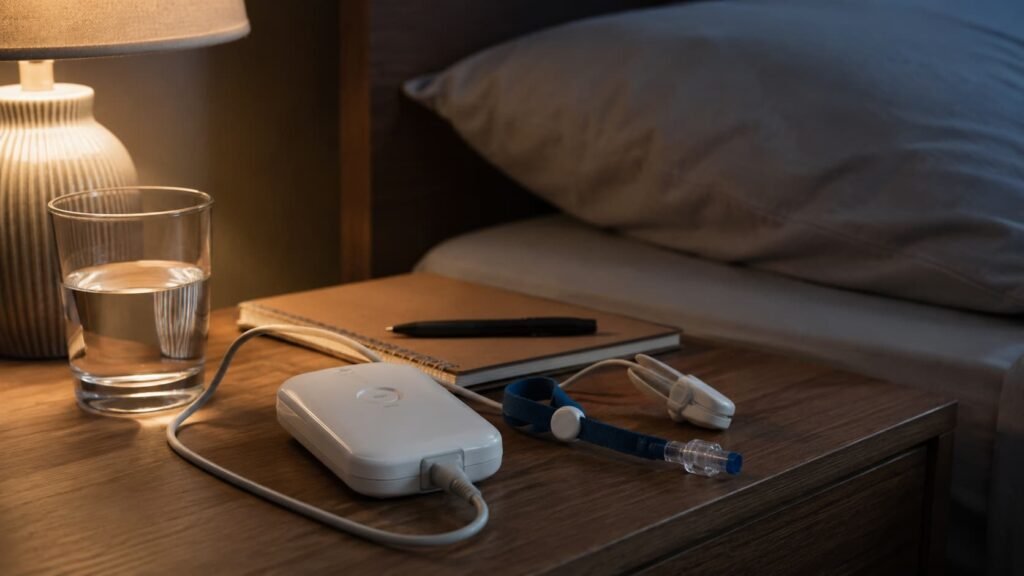
The diagnostic process has gotten more accessible. Home sleep tests — where you wear a small device on your finger and wrist overnight — are now common and often covered by insurance in the US. They’re not as precise as a full in-lab polysomnography but they catch most cases. Worth asking your doctor about, especially if the anxiety picture has never quite made sense.
And if you’ve been treating anxiety for a while with limited progress, bringing up sleep quality in that conversation is reasonable. It’s not dramatic. It’s just another variable worth checking.
Frequently Asked Questions
Q: Does sleep apnea cause anxiety?
A: Yes, it can. Sleep apnea repeatedly activates the body’s stress response overnight through oxygen drops and micro-arousals, leading to sustained cortisol elevation and a nervous system that’s chronically primed for threat. Over time, this physiological stress can manifest as anxiety symptoms — even when nothing in your waking life explains the anxiety.
Q: Can treating sleep apnea reduce anxiety?
A: For many people, yes. Research published in the journal Sleep found that CPAP therapy — the most common treatment for obstructive sleep apnea — significantly reduced cortisol levels and improved mood in treated patients. Many people report noticeable reductions in anxiety symptoms within weeks to months of starting treatment, though results vary.
Q: How do I know if my anxiety is caused by sleep apnea?
A: There’s no single test for this, but certain patterns are suggestive: anxiety that doesn’t respond fully to therapy or medication, chronic fatigue despite adequate sleep hours, waking unrefreshed, morning headaches, and a history of snoring or witnessed breathing pauses. A home sleep test is a reasonable starting point if you suspect a connection.
Q: Does anxiety make sleep apnea worse?
A: Not directly — obstructive sleep apnea is primarily a structural airway issue that anxiety doesn’t cause. But anxiety can worsen it indirectly through alcohol use to self-medicate, poor sleep positioning, and muscle tension changes that affect airway stability during sleep.
Q: What kind of anxiety does sleep apnea cause?
A: Sleep apnea most commonly produces a generalized, low-grade anxiety — a sense of unease or dread without a specific cause — rather than clearly triggered anxiety. Panic attacks at night, sometimes mistaken for cardiac events, are also associated with sleep apnea due to the sudden oxygen drop and cortisol spike during apnea events.
Q: How long does it take for anxiety to improve after treating sleep apnea?
A: Most people who see improvement start noticing it within 4 to 12 weeks of consistent CPAP use, though some report changes sooner. The nervous system needs time to recalibrate after months or years of disruption. If anxiety doesn’t improve at all after 3 months of consistent treatment, it’s worth talking to a doctor about whether additional support — therapy, medication, or both — makes sense.
Q: When should I see a doctor about sleep apnea and anxiety?
A: If you’re experiencing persistent anxiety that doesn’t respond to standard treatment, combined with symptoms like daytime fatigue, morning headaches, or witnessed breathing pauses during sleep, it’s worth asking for a sleep evaluation. Both conditions are well-understood and treatable — you don’t need to keep living with either one as a permanent background noise.
The version of me from five years ago would have dismissed the sleep apnea angle entirely. I thought anxiety was just my personality, something to manage around rather than something with a fixable upstream cause. Turns out I was wrong — or at least, not entirely right. The anxiety was real. But it had a lot of help from a breathing problem I didn’t know I had.
If there’s a lingering thread in your own anxiety that never quite gets resolved no matter what you try — it might be worth pulling on it.
This article is for informational purposes only and does not constitute medical advice. Always consult a qualified healthcare professional before making changes to your health routine.
This article is for informational purposes only and does not constitute medical advice. Always consult a qualified healthcare professional before making changes to your health routine.