passionflower for sleep is one of those topics that kept coming up when i was researching natural alternatives to melatonin. if you’ve tried melatonin and it either knocked you out too hard or just… didn’t work, you’re not alone. if you’ve tried melatonin and it either knocked you out too hard or just… didn’t work, you’re not alone. a lot of people end up in this weird middle ground where they’re exhausted but still lying awake, scrolling through their phone at midnight wondering what’s wrong with them.
passionflower kept coming up when i was researching this. not in a trendy supplement way — more in the quiet, “this has actually been used for centuries and there’s real research on it” way. so i went down the rabbit hole.
here’s what i found.
what is passionflower, exactly
it’s a climbing vine — Passiflora incarnata, if you want the full name — originally from the southeastern united states but now grown widely across europe and south america. the leaves, stems, and flowers have all been used medicinally for a long time, mostly for anxiety and sleep.
the reason it works comes down to one main mechanism: GABA.
GABA is basically your brain’s brake pedal. not a perfect analogy, but close enough. when there isn’t enough of it — or when it’s not binding well — your nervous system just kind of keeps running. not in a panicked way necessarily. more like a computer that won’t fully sleep. thoughts surface. then more thoughts. your body is tired but the system hasn’t gotten the memo.
passionflower contains compounds, particularly flavonoids like chrysin, that seem to nudge this system in the right direction — enhancing GABA activity in the brain without the blunt-force effect of something like a prescription sedative.
it’s not knocking you out. it’s more like… turning down the volume.
does it actually work
the research is modest in scale but fairly consistent in direction.
a 2011 study published in Phytotherapy Research gave participants either passionflower tea or a placebo for a week. the passionflower group reported meaningfully better sleep quality — specifically around how rested they felt in the morning and how easily they fell asleep. the researchers noted the effect was real but subtle. not a sedative effect. more like reduced nighttime wakefulness.
a separate study looked at passionflower extract in people with generalized anxiety disorder and found it performed comparably to a low-dose benzodiazepine for anxiety symptoms, with fewer side effects around cognitive impairment. that matters for sleep because anxiety and sleep problems are deeply tangled — if you’ve ever lain awake with a spinning mind, you already know this.
there’s also animal research suggesting passionflower may affect sleep architecture, specifically increasing the proportion of slow-wave sleep. that’s the deep, restorative stage that most people aren’t getting enough of.
none of this is “take passionflower and you’ll sleep eight hours.” but if your sleep problem is more about a restless, anxious mind than actual inability to feel tired, it might be one of the more targeted natural options available.
7 ways to use passionflower for sleep
1. passionflower tea, 30–60 minutes before bed
this is the most traditional form and probably the most studied. you steep the dried herb — leaves and flowers — for about ten minutes. the ritual itself matters. making tea, sitting with it, not looking at a screen — that transition signals to your nervous system that the day is actually ending.
the studies generally used around one cup — brewed from roughly 2g of dried herb. commercial tea bags don’t always tell you exactly what’s in them, so it’s worth checking, though honestly most standard sleep tea blends land somewhere in that range.
taste-wise: earthy, a bit floral, not unpleasant but not exactly exciting either. a lot of people mix it with chamomile — which isn’t a bad idea since chamomile has its own mild sleep-supportive thing going on. if you’re already doing the chamomile tea routine, adding passionflower is a pretty low-effort upgrade. 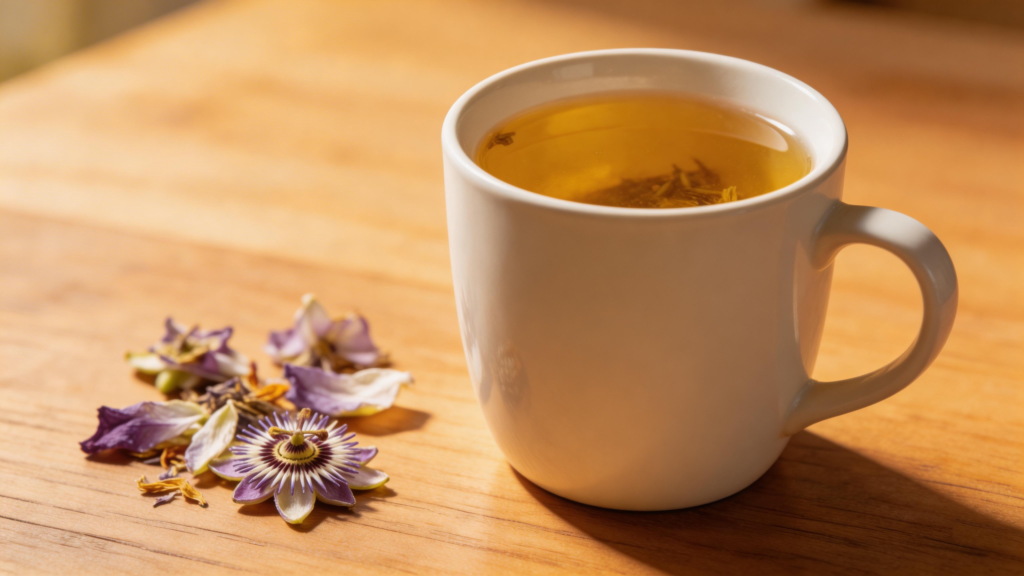
2. liquid extract or tincture
tinctures — alcohol-based liquid extracts — are absorbed faster than capsules and are easier to dose precisely. standard doses in clinical use range from 45 drops to about 1ml taken in a small amount of water before bed.
the trade-off is taste. passionflower tincture is bitter and earthy. a lot of people mix it into juice or add it to their tea.
3. capsules or tablets
if you just want the effect without the taste or preparation, capsules are the most convenient option. look for standardized extracts — products that specify the percentage of active flavonoids give you more predictability than plain powdered herb.
typical supplemental doses range from 200mg to 500mg. there’s no firmly established “optimal” dose yet, so starting at the lower end and adjusting makes sense.
4. combine it with valerian
passionflower and valerian are frequently studied and sold together, and the combination appears to work better than either alone for some people. valerian has a more sedative quality while passionflower addresses the anxious-mind component more specifically. if one hasn’t worked for you on its own, the combination is worth trying.
some commercial sleep supplements already pair them. just check that the formulation isn’t also stuffed with melatonin and five other things — hard to know what’s actually helping when everything is in there at once.
5. use it specifically on high-stress nights
unlike melatonin, which works partly through timing and circadian mechanisms, passionflower’s primary action is anxiety-modulating. this makes it particularly useful on situational nights — before a big meeting, after an argument, when your brain just won’t stop.
if you sleep fine most nights but have predictably bad ones, passionflower might make more sense as an as-needed tool than a nightly ritual.
6. pair it with magnesium
magnesium glycinate has its own evidence for sleep, partly through muscle relaxation and partly through supporting GABA function — which overlaps with passionflower’s mechanism. some people find the combination particularly effective for the kind of sleep that’s physically restless rather than just mentally active.
if you’re already taking magnesium for sleep, adding passionflower doesn’t seem to create any interaction concerns at typical doses. but it’s worth not stacking everything at once — introduce one thing at a time so you know what’s actually working.
7. passionflower bath or aromatherapy
this one has less direct research behind it, to be honest. but for people who are sensitive to supplements or prefer not to ingest anything, passionflower essential oil used in a diffuser or added to a warm bath may provide some relaxation benefit through the ritual and the mild inhalation of its aromatic compounds.
warm baths also independently improve sleep by causing a slight drop in core body temperature after you get out — which is one of the natural signals your body uses to initiate sleep. so even if the passionflower component is minimal here, the bath itself isn’t nothing. 
who might benefit most
the honest answer is that passionflower probably isn’t for everyone equally. the people who seem to get the most out of it are dealing with a specific thing — not just tiredness, but that wired-but-exhausted state where the mind won’t actually stop. the kind where you’re lying there replaying a conversation from three days ago or mentally composing an email you haven’t written yet. if that’s familiar, the GABA mechanism makes sense for that.
if your problem is more structural — you go to bed at wildly inconsistent times, you’re on your phone until 1am, your schedule is basically chaos — passionflower isn’t going to fix that. something like actually resetting your sleep schedule matters more in that situation. supplements and habits aren’t really substitutes for each other.
and the racing thoughts at bedtime thing — that’s its own rabbit hole, honestly. passionflower is one piece of it. not the whole answer.
it’s also worth placing passionflower somewhere in the wider landscape of natural sleep stuff, because not everything works the same way. chamomile is milder — one compound, one mechanism, pretty gentle overall. valerian is more sedative-forward, which some people find too heavy. glycine works through amino acid pathways, tart cherry juice through melatonin precursors. passionflower is doing something different from all of them. whether that’s better or worse depends entirely on what’s actually keeping you up.
what to watch out for
safety-wise, passionflower has a pretty good track record. it’s been used for a long time and at normal doses most people don’t report much beyond some drowsiness — which, again, is kind of the goal. occasionally someone gets a bit of stomach upset or feels slightly dizzy, but that’s not common.
a few specific cautions:
pregnancy. passionflower has historically been used to stimulate uterine contractions and should be avoided during pregnancy.
sedative medications. if you’re taking benzodiazepines, sleep medications, or other sedatives, combining them with passionflower could produce additive effects. talk to your doctor before combining.
surgery. some sources suggest stopping passionflower use about two weeks before any scheduled surgery because of potential interactions with anesthesia.
for otherwise healthy adults using it occasionally for sleep, these concerns are unlikely to apply. but they’re worth knowing.
how long does it take to work
this is where expectations matter. passionflower isn’t melatonin — you won’t necessarily feel something specific within an hour.
the research showing sleep quality improvements used a one-week protocol. for some people the effect is noticeable within a few nights; for others it takes consistent use over a week or two before the benefits become clear. if you’ve taken it once or twice and felt nothing obvious, that doesn’t necessarily mean it’s not working.
the more anxious your baseline state, the more likely you are to notice something relatively quickly. people with lower baseline anxiety might see subtler effects.
a few final thoughts
i want to be careful not to oversell this. passionflower isn’t a cure for chronic insomnia or any underlying sleep disorder. if you’re waking up at 3am every night or haven’t slept properly in months, a herb isn’t the starting point — understanding what’s actually causing it is.
but for the enormous number of people who sleep mostly fine except when life gets stressful — and who’d rather not reach for melatonin or something stronger every time — passionflower sits in a genuinely useful niche. it’s been around long enough that we have decent evidence. the mechanism makes biological sense. and the risk profile is about as low as it gets for this kind of thing.
whether that’s enough to make it worth trying tonight is really up to you. i’m not going to tell you it’ll definitely work. what i will say is that the people who tend to benefit most are the ones who also take the other basics seriously — the sleep schedule, the light exposure, the wind-down routine. passionflower as a supplement to a solid foundation is a different thing than passionflower as a substitute for one.
This article is for informational purposes only and does not constitute medical advice. Always consult a qualified healthcare professional before making changes to your health routine.